Moving abroad: who should you notify about your new address?
Published
Setting up a US mailing address is one part of moving abroad. The next is making sure the right people and organisations have the details they need.
Some only need somewhere to send correspondence. Others also need to know where you actually live, whether your circumstances have changed or how to contact you overseas.
Work through important accounts individually rather than replacing every address with the same US mailbox. This checklist helps you organise those updates without overlooking the distinction. For choosing and managing the mail arrangement itself, read how to manage your US mail when moving abroad.
We may earn a commission if you sign up through links in this guide.

Start with three separate details
Before updating accounts, write down:
| Detail | What it is for |
|---|---|
| Mailing address | Receiving correspondence, whether in the US or abroad. |
| Residential address | Recording where you actually live. |
| Contact details | Reaching you by email or phone, including account verification. |
Use each organisation’s instructions to decide what belongs in its fields. A mailing-address update does not necessarily complete its residence, tax-information or eligibility requirements.
Our guide to using a virtual mailbox as a permanent address explains why those distinctions matter.
1. Banks, credit cards and investment providers
Start with accounts you rely on for everyday spending, savings and ongoing payments.
Ask how to record your overseas residence and whether a separate US mailing address is accepted. Also ask whether living in your destination country affects the account or services available.
Federal bank customer-identification rules distinguish address requirements from simply choosing where correspondence arrives. A commercial mailbox should not be assumed to satisfy residential-address verification.
Review:
- Mailing and residential details.
- Phone numbers used for security codes.
- Paperless statements and notices.
- Replacement-card delivery arrangements.
- Any requested updates to residency or tax information.
Test account access before departure, particularly if you plan to stop using your US phone number.
2. The IRS and your tax preparer
Notify your tax preparer and follow the IRS address-change process.
The IRS lists several methods, including entering a new address on a tax return or submitting Form 8822 for individual address changes. It specifically advises notifying the IRS directly because postal forwarding does not reliably cover all government checks.
Use the official IRS address-change guidance to choose the appropriate method.
Record the date you submitted the update. Keep changes to correspondence details separate from questions about filing obligations or tax residence.
3. Social Security, pensions and other benefits
If you receive benefits, contact the administering organisation about the move—not just the address label.
For Social Security, use its guidance for beneficiaries leaving the United States and the relevant international contact arrangements. SSA provides resources specifically for people living abroad or planning to leave.
For other pensions or benefits, ask:
- How should I report my overseas address?
- Does the move require any additional information?
- How will I receive and return important correspondence?
- Which contact details should I keep current?
Follow the process for the particular benefit rather than assuming every programme works alike.
4. Insurers and healthcare arrangements
Include health, vehicle, home, renters and life insurance where relevant.
Explain the actual change: whether you are leaving a property empty, renting it out, keeping a vehicle in the US or moving your household overseas.
Ask what needs updating beyond the mailing address and whether your existing arrangements remain suitable. Keep written confirmation of any agreed changes.
Also review how healthcare providers and insurers will send outstanding bills, records and other correspondence after you leave.
5. Property, loans and household accounts
If you retain a US property, include:
- Mortgage or loan servicers.
- Property managers and homeowners’ associations.
- Local property-tax offices.
- Utilities and home-service providers.
- Anyone responsible for maintenance or access.
If you are leaving a rental, give the landlord a dependable address for final correspondence and deposit-related matters.
Separate closing an account, transferring responsibility and changing its contact details. Updating an address alone may not accomplish the task you intended.
6. State agencies and vehicle-related records
Review the agencies connected with any driving licence, vehicle registration or title you hold.
Follow their procedures for your circumstances. Do not assume that keeping a US mailing address means every existing record can remain unchanged after an overseas move.
Where an official address use is uncertain, start with the AddressWise tools and the relevant agency’s requirements.
7. Employers and professional contacts
Include your current or former employer, payroll department and any organisation likely to send employment documents.
Tell accountants, lawyers and other advisers how to contact you. If you have ongoing professional memberships, update their correspondence preferences too.
Keep a dependable email address on file so a missed postal letter is not the only way someone can reach you.
8. Subscriptions, shopping accounts and personal contacts
Once essential accounts are covered, work through:
- Magazines and other postal subscriptions.
- Shopping accounts and saved delivery addresses.
- Charities and membership organisations.
- Friends and family who send letters or gifts.
Check the selected address before each order. A virtual mailbox may suit correspondence while your overseas home is the intended destination for a purchase.
Cancel unwanted paper mail where practical.
Don’t rely on USPS forwarding alone
USPS says a change-of-address order changes postal delivery arrangements; you remain responsible for notifying agencies, companies and other senders. Some sensitive mail has forwarding restrictions.
Use forwarding as part of the transition, alongside direct updates.
Review incoming mail after the move. Letters still addressed to your old home can help identify senders you missed.
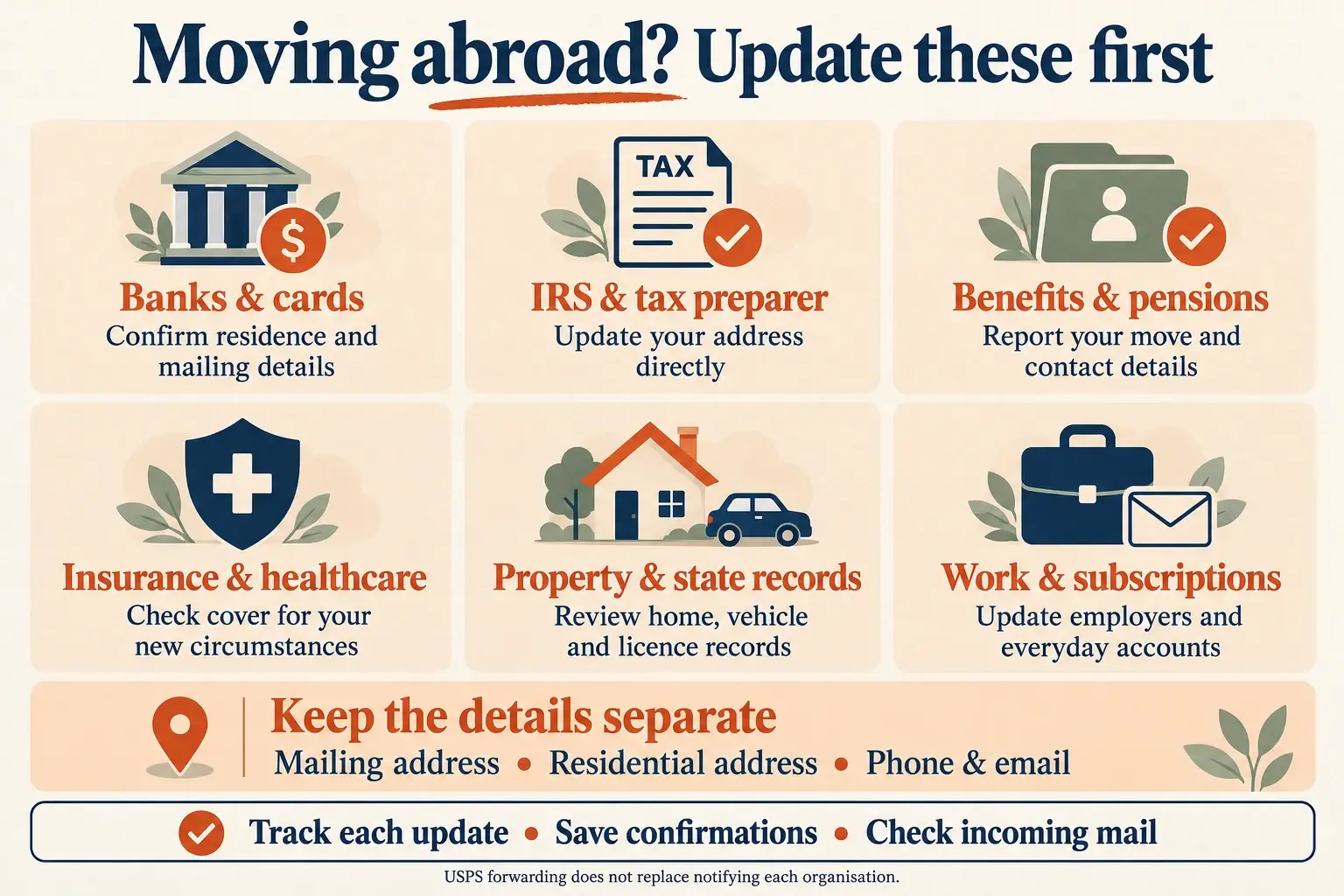
Keep one simple update tracker
Use a list like this:
| Organisation | Mailing details updated | Residence/contact details reviewed | Confirmation saved |
|---|---|---|---|
| Bank or card provider | ☐ | ☐ | ☐ |
| IRS and tax preparer | ☐ | ☐ | ☐ |
| Benefits or pension provider | ☐ | ☐ | ☐ |
| Insurer | ☐ | ☐ | ☐ |
| Property or loan account | ☐ | ☐ | ☐ |
Add a submission date and follow-up note where needed. Store confirmations securely without putting passwords or full account numbers into the checklist.
Arrange somewhere dependable for US correspondence
A virtual mailbox can help you read US letters while you are abroad, provided the sender accepts it for the mailing purpose involved. It does not replace reporting your actual residence where required.
Traveling Mailbox is our preferred service for remote mail access. Explore its plans, or compare estimated mailbox costs.
For the practical setup sequence, read How to manage your US mail when moving abroad.
Start with the accounts where missed correspondence would matter most, keep a record of each update and check what still arrives after you move.
For help opening your mailbox, follow our virtual mailbox setup checklist.