How to receive mail while travelling full-time in an RV
Published
When your next address is a campground rather than a permanent home, receiving mail takes a little planning. You need somewhere dependable for letters to arrive, a way to read important correspondence and a delivery arrangement for anything you need physically.
A useful setup separates two things: your regular mailing address and your current collection point. The first can stay consistent while the second changes with your journey.
Here’s how to put that into practice.
We may earn a commission if you sign up through links in this guide.
1. Choose a regular place to receive mail
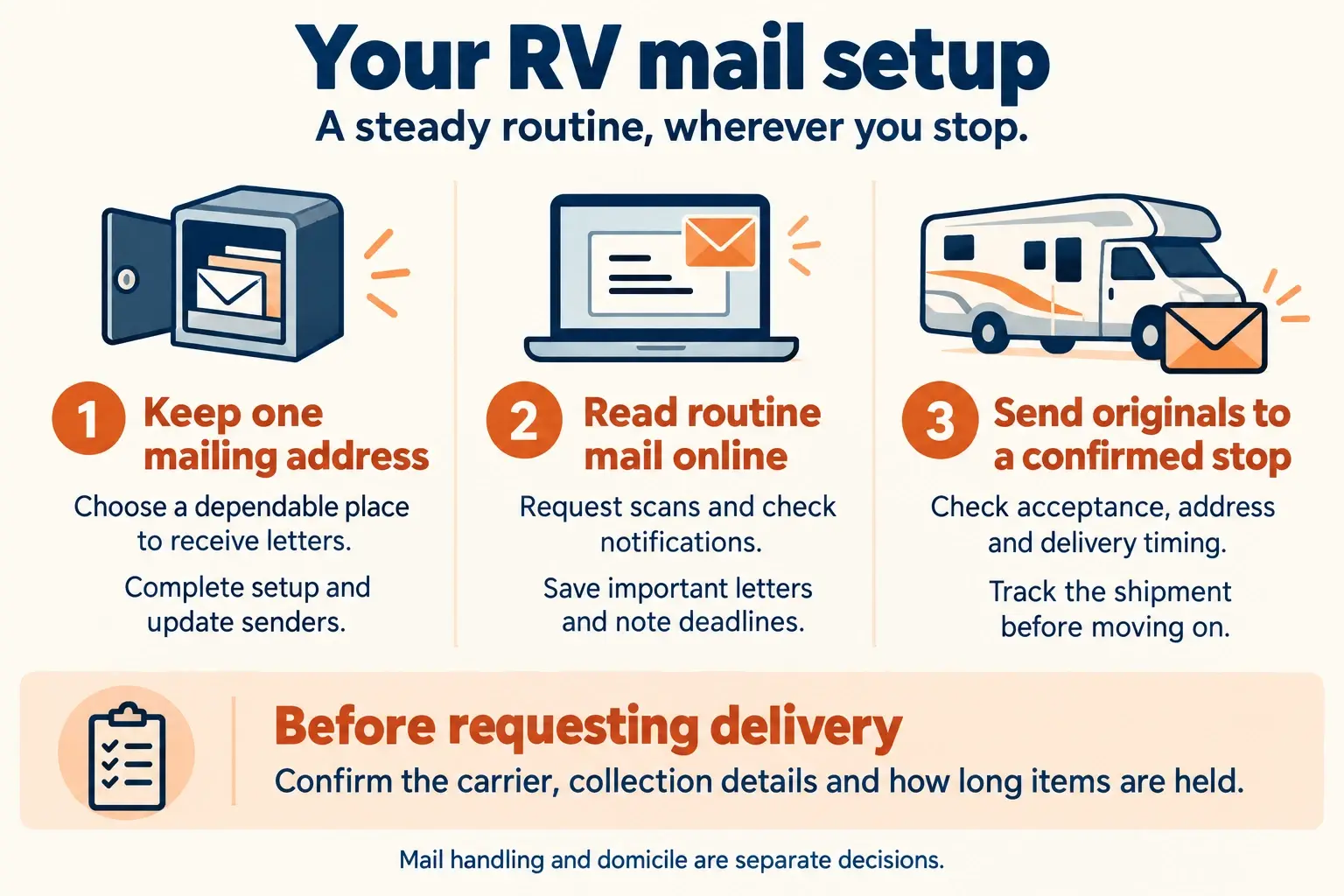
Avoid building your everyday mail arrangements around each overnight stop. Instead, choose somewhere that can receive correspondence consistently.
Your options include a trusted person, a mail-forwarding service or a virtual mailbox. A USPS PO Box is another possibility if you or an authorised person can collect mail regularly; it is a physical collection point rather than a content-scanning service.
Think about what happens after a letter arrives. Who tells you about it? Can you read it remotely? How will you receive an original?
If you’re still choosing, read Virtual mailbox vs PO Box vs mail forwarding.
USPS PO Boxes: features and service conditions
2. Read routine letters online
A virtual mailbox can reduce the number of physical deliveries you need to coordinate.
Traveling Mailbox shows incoming envelope images online. You can request opening and scanning, then read the contents without waiting for the original to reach your next stop. It also lets you request physical forwarding when needed.
For example, a routine letter might only need reading and saving. An item you must present in person needs a different decision: retain it and arrange delivery.
Traveling Mailbox is our preferred service for remote mail access. Explore its plans, or compare estimated mailbox costs using your likely mail volume.
Check included scanning carefully. Ten letters containing three pages each means 30 scanned pages, which may be priced differently from ten scan requests.
3. Finish setup before changing your mailing address
Complete the provider’s identification process and confirm your account is ready before sending important correspondence there.
Traveling Mailbox requires USPS Form 1583 to authorise it to receive your mail. That form does not redirect letters from your previous address. You still need to update senders or arrange appropriate forwarding.
Keep the exact address format and mailbox number somewhere accessible. Send a test letter and check that notifications and account access work.
Also confirm that the account covers everyone whose mail will arrive.
4. Update senders directly
Make a list of organisations that still send important letters. Update their mailing details and record which changes are complete.
USPS forwarding may help during the transition, but it has conditions and different treatment for different mail classes. Don’t use it as your only long-term arrangement.
Where an organisation asks separately for a residential address, keep that distinct from your mail-delivery instructions. Read Can you use a virtual mailbox as your permanent address? before treating the new mailbox as an address for every purpose.
USPS forwarding: options and service conditions
5. Arrange physical delivery around a dependable stop
Before requesting an original letter or a bundle of mail, confirm that your intended destination will accept it.
For a campground or RV park, ask:
- Do you accept mail for guests?
- Which carriers can deliver here?
- What exact address and guest details should I use?
- How long will you hold an item?
- What happens if it arrives after I leave?
These are questions to ask the particular location, rather than services to assume every campground offers.
Allow time for the mailbox provider to prepare the shipment as well as the carrier’s delivery. Choose a stop where you expect to remain long enough to collect it, and track the shipment.
If your route changes, contact the receiving location promptly. Avoid requesting automatic deliveries to an address you may soon leave.
6. Keep domicile separate from mail handling
A convenient mailbox does not, by itself, settle your domicile or establish that its address works for a driving licence, vehicle registration, banking or insurance.
If you are considering a change of home base, assess the relevant state's domicile and official address requirements before committing to a particular arrangement.
You may need a qualifying domicile-address service alongside online mail handling. Don’t assume that a virtual mailbox in your preferred state provides both.
For state licensing requirements, read Can you use a virtual mailbox for a driver's license?.
7. Make checking mail part of your routine
Enable notifications and check incoming correspondence regularly. Save important scans, note deadlines and decide promptly which originals you need to keep.
Review the provider’s physical retention rules before leaving items untouched. Reading a scan does not necessarily mean the original will be held indefinitely.
Secure the account with a unique password and any additional security options available. Keep access to the associated email account working while you travel.
Your RV mail checklist
- Choose a dependable regular mailing address.
- Complete verification and test delivery.
- Update important senders.
- Read routine correspondence online where useful.
- Confirm each physical collection point before shipping.
- Keep mailing arrangements separate from domicile decisions.
- Check notifications and deal with originals promptly.
The aim is a steady mail routine that keeps working when your campsite changes.
Compare estimated mailbox costs, or explore Traveling Mailbox for remote mail access.