Can You Use a Virtual Mailbox for a Driver's License?
Published
A virtual mailbox may be useful for receiving driver's license correspondence, but it usually cannot replace the residential address required by a state DMV. Whether you can use one depends on the state, the purpose of the address and your circumstances.
For most applicants, the important distinction is between an address where you receive mail and an address that establishes where you live.
There are also exceptions for certain full-time travellers, although these can involve much more than simply purchasing a virtual mailbox.
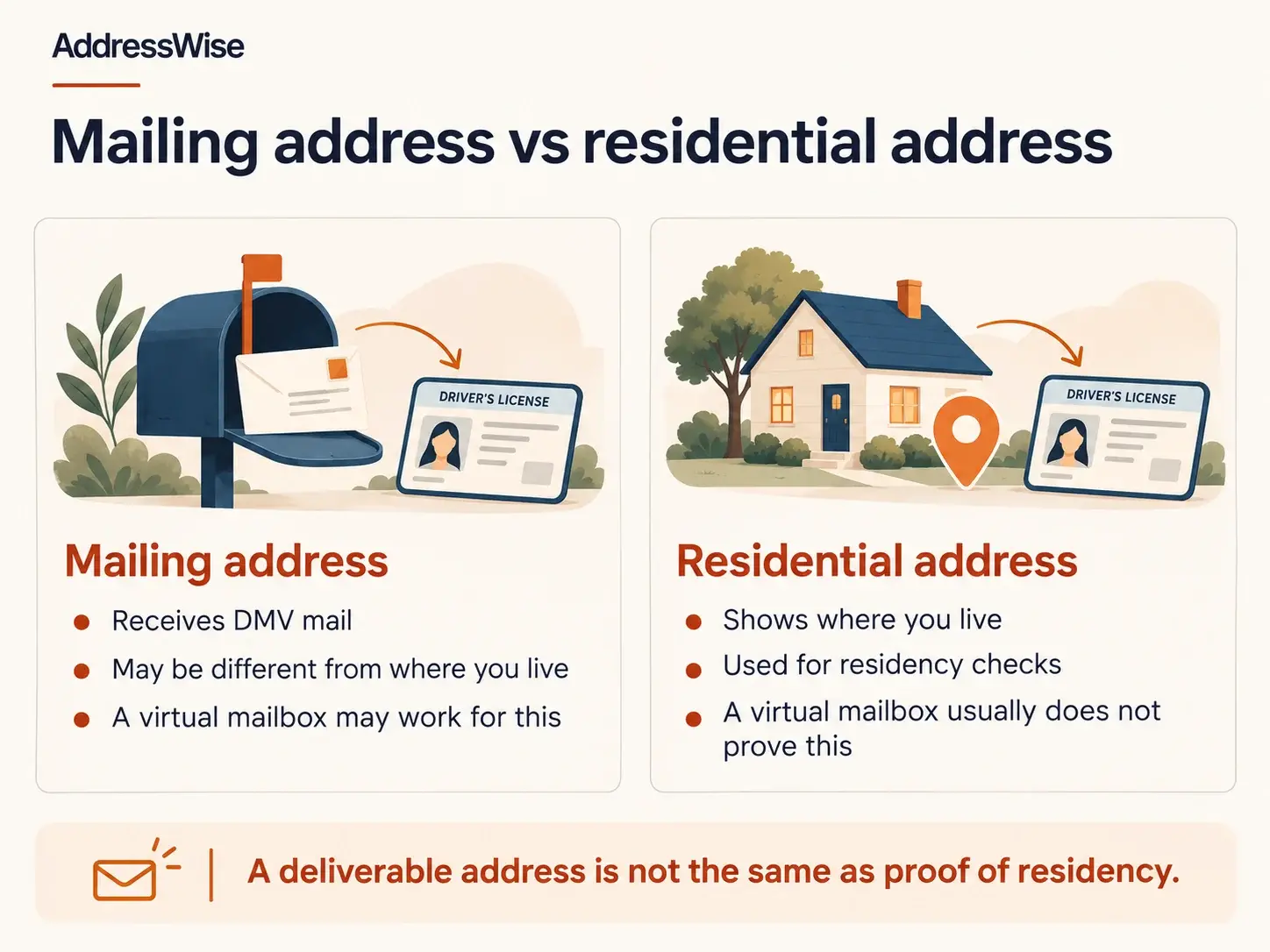
Mailing address vs residential address: what's the difference?
A virtual mailbox gives you an address where a commercial mail-receiving business accepts correspondence on your behalf. Depending on the service, you may be able to view envelopes online, request scans or arrange forwarding.
That makes it useful for managing mail. It does not necessarily make the mailbox location your legal residence.
For driver's licensing, three different questions matter:
| Address use | What you need to establish |
|---|---|
| Receiving DMV correspondence | Whether the agency permits your chosen mailing address for the correspondence or document involved |
| Entering a mailing address on an application | Whether the application allows a separate mailing address and accepts that type of address |
| Proving state residency | Whether you have acceptable evidence of an actual residence or qualify under a special state procedure |
A virtual mailbox might work for the first purpose but not the third.
For example, an applicant may live at one address while having correspondence delivered elsewhere. The state can still require evidence of where that person actually resides.
A deliverable mailing address is not the same as proof of residency.
For the wider distinction between mailing addresses, residential addresses and domicile, see Can you use a virtual mailbox as your permanent address?.
Can you use a virtual mailbox for a driver's license in different states?
There is no single nationwide answer. States issue driver's licenses under their own requirements, alongside applicable federal standards for REAL ID-compliant identification.
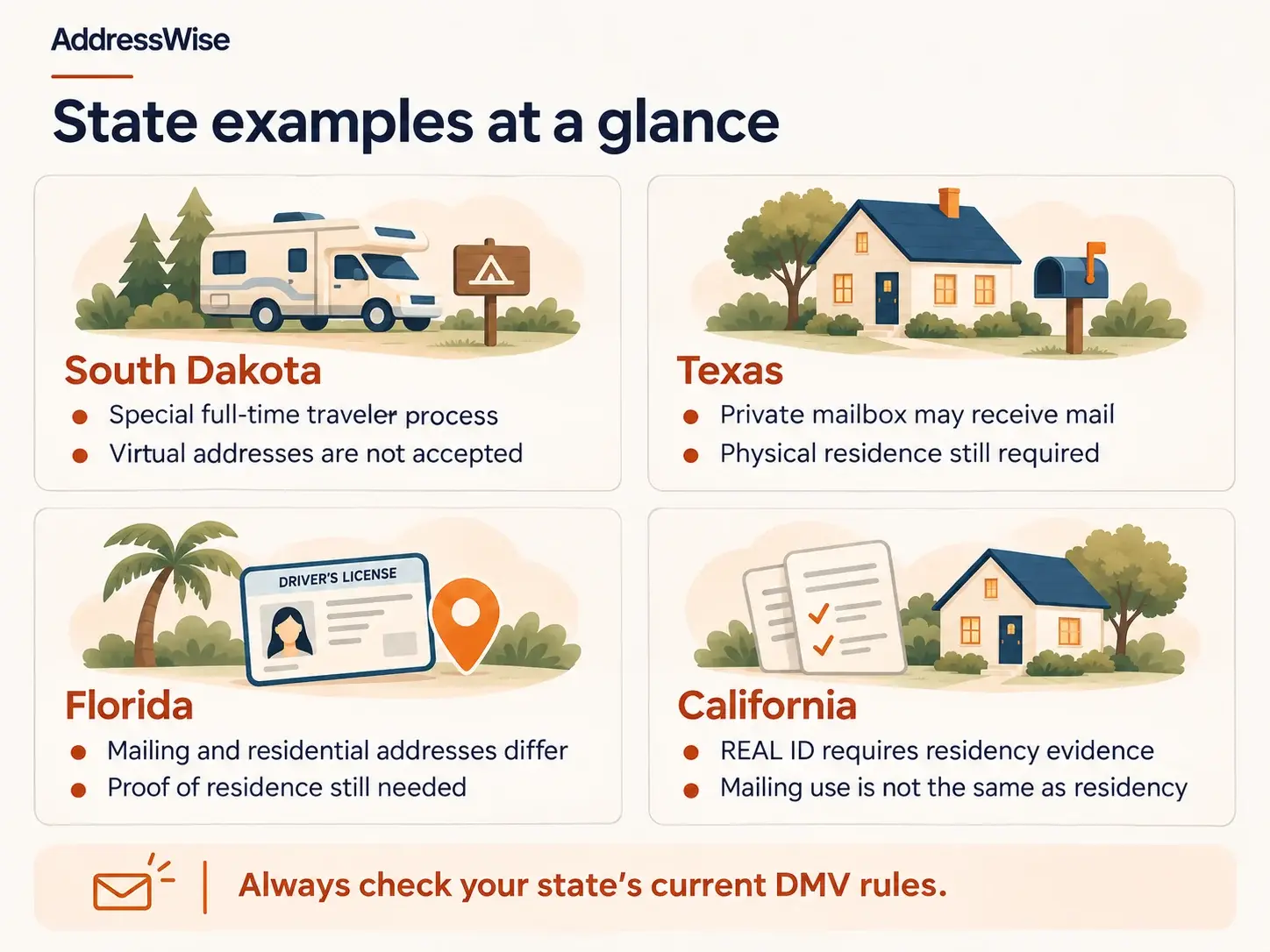
The following examples illustrate why checking your state's rules matters.
South Dakota: special rules for full-time travellers
South Dakota has an established licensing procedure for qualifying people who live full-time in an RV or camper, or travel full-time for work.
Its published renewal and replacement guidance for travellers using a personal mailbox service includes:
- A completed, notarized residency affidavit.
- A receipt showing an overnight stay at a South Dakota hotel, motel, campground or RV park within the previous year.
- Documentation showing the applicant's name and qualifying South Dakota personal mailbox address.
Additional identity and licensing requirements also apply. The precise documentation and procedures depend on the application or renewal circumstances. First-time South Dakota applicants must attend in person; confirm the documents for your application directly with Driver Licensing.
There is a particularly important restriction: South Dakota explicitly states that virtual addresses or virtual postal addresses are not accepted as the qualifying address evidence described in its traveller guidance.
This means you should not assume that a conventional online virtual mailbox subscription will qualify simply because it provides a South Dakota street address.
If you intend to use a mail-forwarding or personal mailbox service for this purpose, confirm the arrangement and required documentation directly with South Dakota Driver Licensing before paying for the service.
Official source: South Dakota DPS, Driver License Information for Full-Time Travelers.
Texas: a private mailbox does not replace a physical residence
Texas generally requires two documents establishing the applicant's residential address. Its residency guidance also provides affidavit procedures and specified exceptions for eligible applicants.
Texas law makes an important distinction concerning the delivery of driver's licenses.
Under Transportation Code §521.1427, private mailboxes are included within the provision dealing with post office box addresses. Unless a state or federal legal exception applies, an applicant may receive a license at such an address only after providing the department with the physical address where they reside.
The department may request evidence to verify that physical address.
In other words, using a private mailbox for delivery does not mean the private mailbox has become an acceptable residential address.
Official sources: Texas DPS Residency Requirements and Texas Transportation Code, Chapter 521.
Florida: mailing and residential addresses are separate
Florida driver's license applications distinguish between a mailing address and proof of residential address.
Florida law requires applicants to supply residential-address evidence satisfactory to the department. A separate mailing address may also be provided.
The state generally requires two approved residential-address documents. It also provides a Certification of Address procedure for certain applicants who genuinely live with another person but do not have sufficient qualifying documents in their own name.
That procedure is not permission to claim residence at an address where you do not live.
A virtual mailbox may help someone manage correspondence, but it does not independently establish Florida residency.
Official sources: Florida Statutes §322.08 and FLHSMV Certification of Address, Form HSMV 71120.
California: a PO Box can be used for some mailing purposes
California's REAL ID requirements illustrate the difference between receiving mail and proving residency.
Applicants must provide qualifying residency evidence. California's official REAL ID checklist specifically addresses applicants using a PO Box.
Its guidance allows a document showing both the PO Box and physical residential address, while another qualifying document may show the PO Box alone.
This does not eliminate the underlying requirement to establish California residency.
Nor should the state's guidance about a USPS PO Box automatically be interpreted as approval for every type of commercial virtual mailbox.
Check the precise address and documents with California DMV before applying.
Official source: California DMV REAL ID Checklist.
What if you live full-time in an RV?
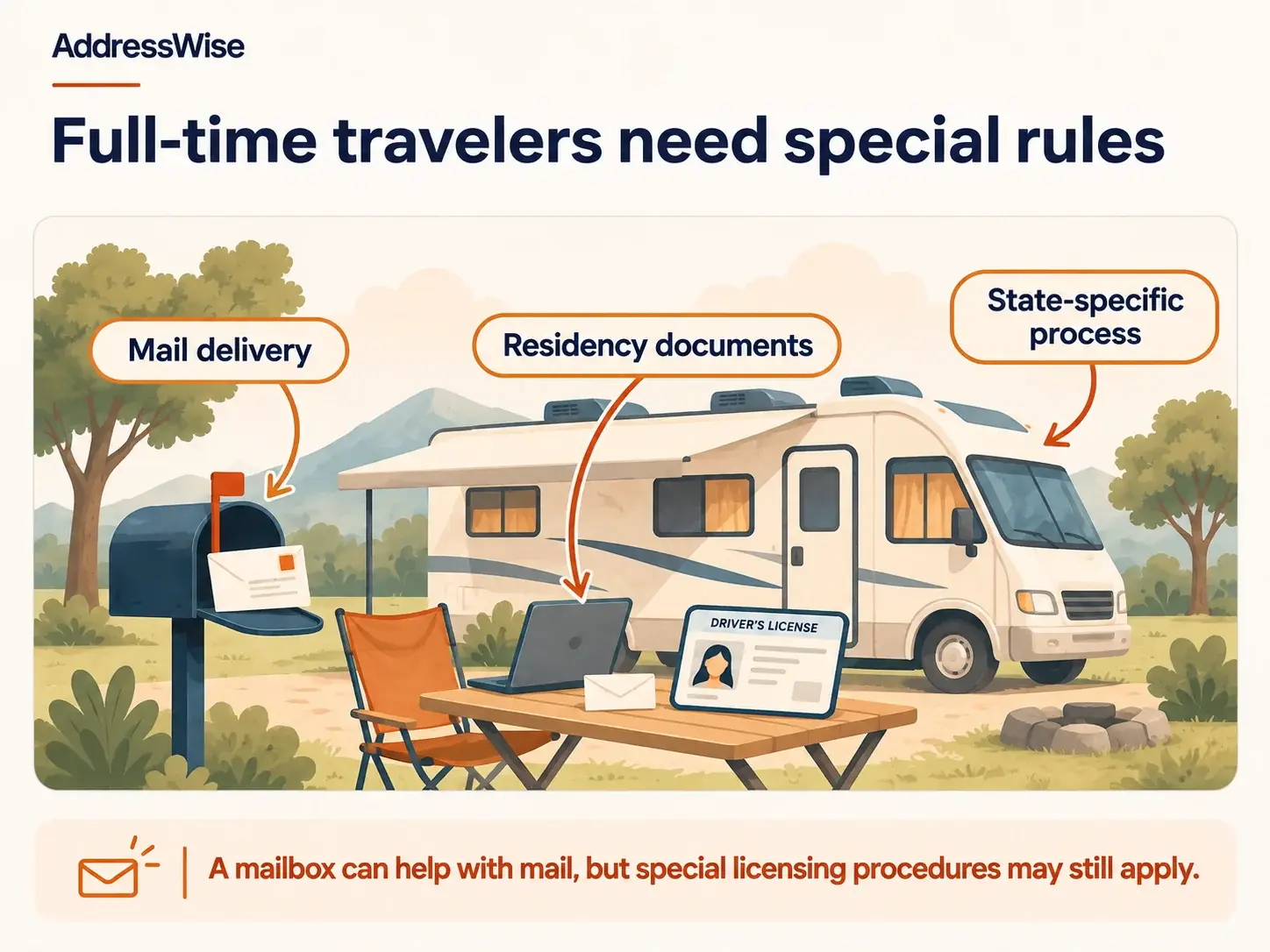
Full-time RVers face a genuine practical difficulty: they may have no conventional home address, even though they still need a driver's license, vehicle registration, insurance and reliable mail delivery.
A mail-forwarding address can help solve the correspondence problem. Establishing state residency is a separate matter.
Depending on the state and individual circumstances, the licensing agency may require evidence relating to where you live, permitted alternative documents, a residency affidavit or a specific traveller procedure.
South Dakota's full-time traveller provisions are one example, but they are not a universal rule.
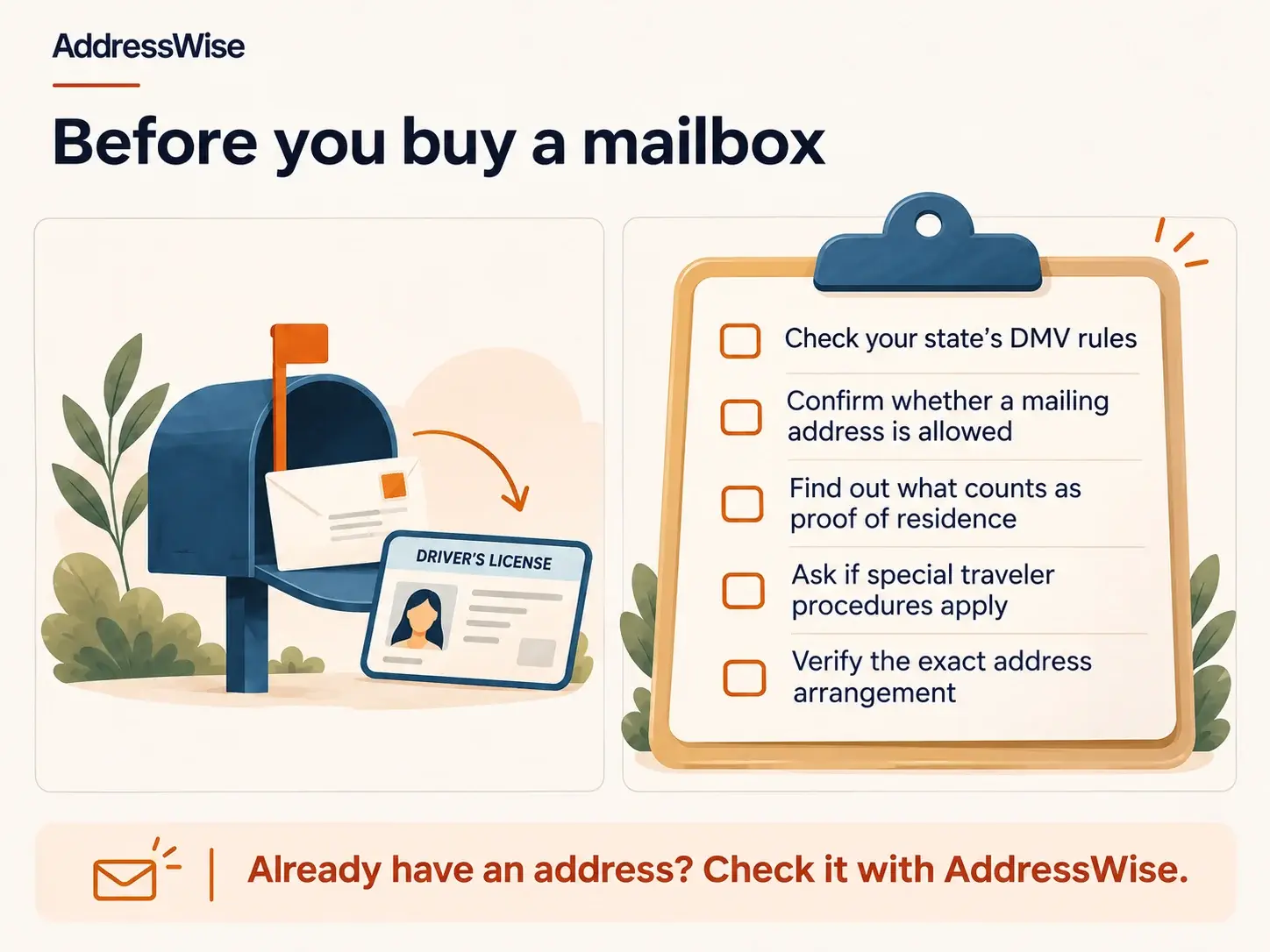
Before arranging a mailbox for licensing purposes, check:
- Whether your state has a procedure for full-time travellers.
- Whether the specific type of mailbox or personal mailbox service is eligible.
- What documents you must supply.
- Whether your initial application or renewal requires an in-person visit.
- Whether separate requirements apply to vehicle registration and insurance.
Do not assume that obtaining a driver's license through a particular procedure will automatically establish residency for every other legal or financial purpose.
For the broader mailing arrangements involved in RV travel, see our guide to receiving mail while travelling full-time in an RV.
What if you're an American living abroad?
A virtual mailbox can be a convenient way to continue receiving US correspondence after moving overseas.
However, maintaining a US mailing address does not, by itself, preserve residency in a particular state or guarantee eligibility for a driver's license renewal.
Your licensing position may depend on whether you remain a resident of that state, the state's renewal rules and any applicable exceptions.
If you have moved overseas permanently, do not use your mailbox provider's premises as your residential address merely because the service gives you a US street address.
Check the appropriate licensing agency's rules for residents living abroad, and consider the licensing requirements of the country where you actually live.
For practical mail arrangements, see our guide to managing US mail when moving abroad.
What if you have no conventional residential address?
Not having a lease, mortgage or utility bill does not necessarily mean you have no route to obtaining identification.
Some states provide alternative documentation procedures for people who genuinely reside with someone else, applicants experiencing homelessness, qualifying travellers and other specified groups.
For example, Texas publishes residency affidavit procedures for eligible applicants who cannot provide the standard two documents. Florida provides a Certification of Address procedure for qualifying applicants whose residential documents are in another person's name.
The details vary considerably.
The correct approach is to ask the licensing agency which procedure applies to your actual living circumstances, rather than entering an address that does not represent where you reside.
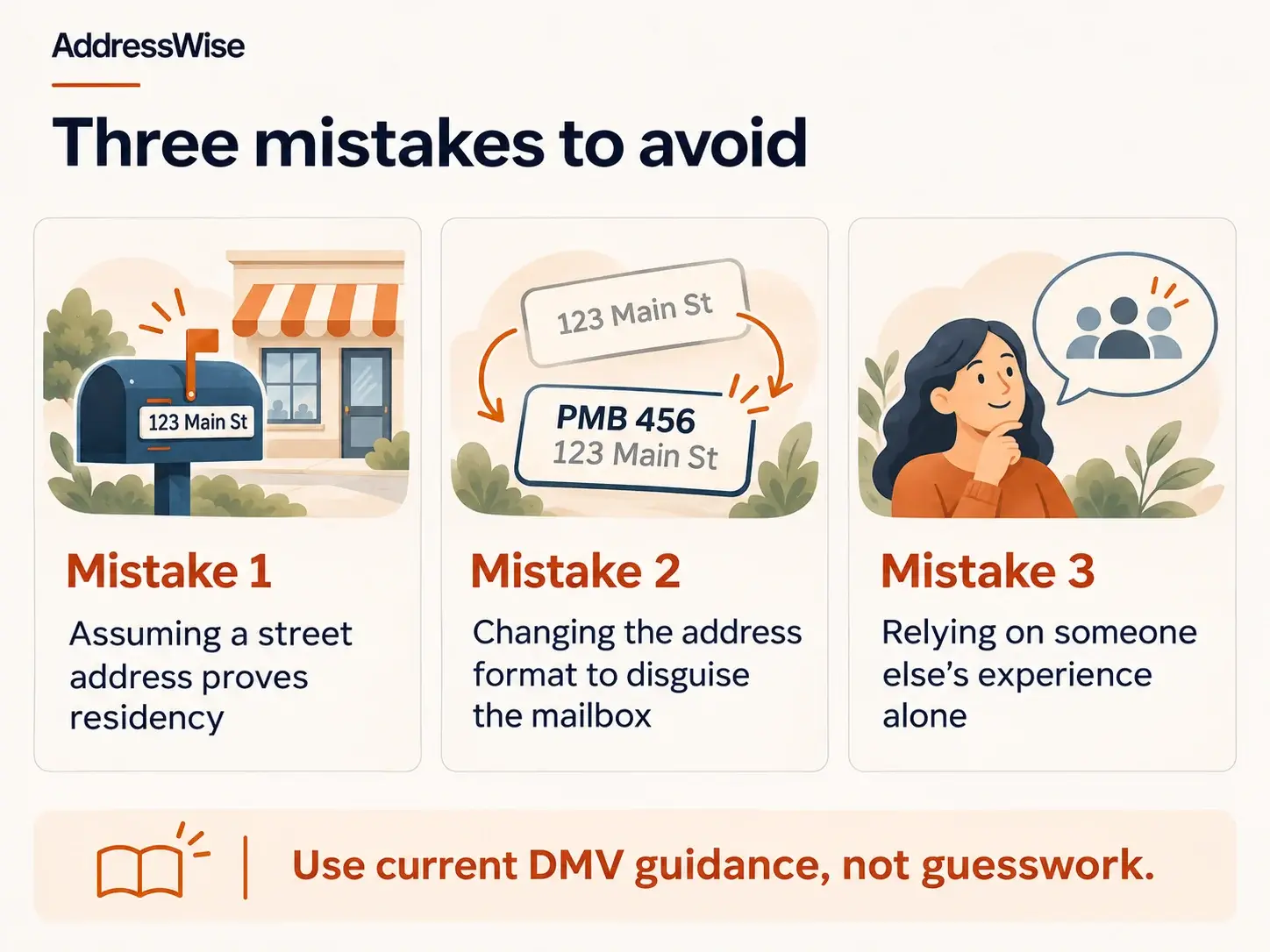
Three mistakes to avoid
1. Assuming a street address means residential acceptance
Many virtual mailboxes use ordinary-looking street addresses.
That does not establish that the premises are your home. The physical building may be a commercial mail-receiving business rather than a residential property.
2. Changing the address format to disguise the mailbox
USPS has specific addressing standards for commercial mail receiving agencies, including the use of PMB or # identifiers.
Replacing the correct designation with an invented apartment or suite number does not turn a private mailbox into a residence.
See USPS Publication 28, Section 285.
3. Assuming somebody else's successful application proves acceptance
A traveller's experience in one state may not apply to another state or even to a different application type.
Rules for initial applications, renewals, REAL ID credentials, mailed documents and special traveller circumstances may differ.
Use current licensing-agency guidance rather than relying exclusively on a mailbox provider's marketing claims or an individual's experience.
Frequently asked questions
Can I have a different mailing address on my driver's license application?
Some states allow a separate mailing address, but the conditions vary. Florida's application requirements explicitly distinguish mailing address information from proof of residential address. Always check your state's application instructions.
Can I use a UPS Store mailbox for my driver's license?
A UPS Store mailbox is a private mailbox arrangement, not automatically a residential address. Whether it can be used for correspondence or licence delivery depends on the state and the particular application. It should not be presented as a residence if you do not live there.
Does a virtual mailbox count as proof of residency?
Not by itself. A mailbox subscription or receipt may prove access to a mailing address, but it does not automatically prove you live at that location. Certain specialist state procedures have their own eligibility and evidence rules.
Can I use a virtual mailbox for REAL ID?
A virtual mailbox alone is not a substitute for the required proof of residency. State REAL ID documentation rules should be checked directly. Some states permit separate mailing addresses or particular combinations of address documents.
Can full-time RVers obtain a driver's license without a fixed house?
Potentially, yes. Some states provide procedures suited to qualifying full-time travellers. South Dakota is one example, but its requirements are specific and do not accept every virtual-address product.
Can I use the same virtual mailbox for my driver's license and vehicle registration?
Do not assume so. Driver's licensing and vehicle registration may involve different address, residency, garaging or documentary requirements. Check both processes separately.
The bottom line
A virtual mailbox can solve the practical problem of receiving mail while travelling, living abroad or moving between addresses. It cannot automatically solve the legal question of where you reside.
Before purchasing a mailbox for driver's licensing purposes, check your state's current requirements and whether the exact address arrangement qualifies.
That distinction can save you from choosing a service that works perfectly well for mail but not for the application you actually need to complete.
Already have a virtual mailbox address?
Check what your address may be suitable for.
AddressWise's Address Checker examines supported address-use categories and identifies known restrictions or conditions based on available rules and address information.
Coverage varies by state and purpose, and some results may remain uncertain.
It can help you investigate a specific address before relying on it, but it does not determine your legal residency or guarantee that a DMV will approve your application.
Check your address with AddressWise
Research reviewed: 13 November 2026.
Editorial note: This guide explains published requirements and common distinctions. It is not a substitute for an individual eligibility determination by the relevant licensing agency. State rules, accepted documents and procedures can change.