Can You Register a Vehicle Using a Virtual Mailbox?
Published
A virtual mailbox may be useful for receiving vehicle registration correspondence, but it generally cannot replace the residential, business or vehicle-location information required by a state motor vehicle agency.
Whether you can use one depends on the state, your circumstances and what you need the address for.
For someone who travels full-time, lives in an RV or receives mail away from home, the distinction matters. A mailbox may solve the problem of receiving renewal notices without establishing where a vehicle must legally be registered.
Before purchasing a virtual mailbox for vehicle registration, it's important to understand the different address requirements.
Vehicle registration involves more than one address
When you register a vehicle, the application may ask for information about both you and the vehicle.
These details serve different purposes.
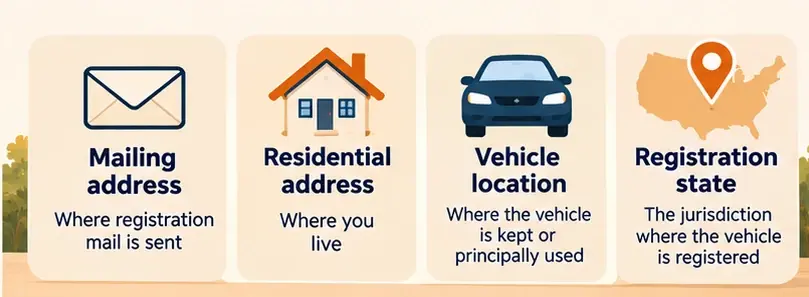
| Address or location | What it means |
|---|---|
| Mailing address | Where the agency sends permitted registration correspondence |
| Residential or business address | Where the vehicle's registered owner lives or operates |
| Vehicle location | Where the vehicle is physically kept or principally used, where relevant |
| Registration state | The jurisdiction in which the vehicle must or may legally be registered |
A virtual mailbox may work for the first purpose without satisfying the others.
For example, California DMV permits a vehicle owner's residential and mailing addresses to differ. Texas also distinguishes a mailing address from the vehicle's physical location.
But neither rule means that purchasing a mailbox automatically makes you eligible to register a vehicle in that state.
Receiving registration mail and qualifying for vehicle registration are two different things.
Can a virtual mailbox receive vehicle registration documents?
Potentially, yes.
Vehicle registration agencies may send renewal notices, correspondence and other documents through the mail. A virtual mailbox service may help receive and manage those items.
Depending on the service and its policies, you may be able to:
- Receive notifications when vehicle-related letters arrive.
- View envelopes online.
- Request scans of eligible documents.
- Have original correspondence forwarded to your current location.
- Maintain a dependable mailing arrangement while travelling.
However, not all registration documents are handled in the same way.
License plates, registration stickers, titles and official documents may have special delivery requirements. Some agencies may require documents to be delivered to an address on record or handled through an authorised process.
Confirm that the motor vehicle agency permits your chosen mailing address for the items you need.
Also check whether the mailbox provider can receive and forward those particular items.
What do different states require?
There is no universal nationwide rule governing virtual mailbox addresses for vehicle registration.
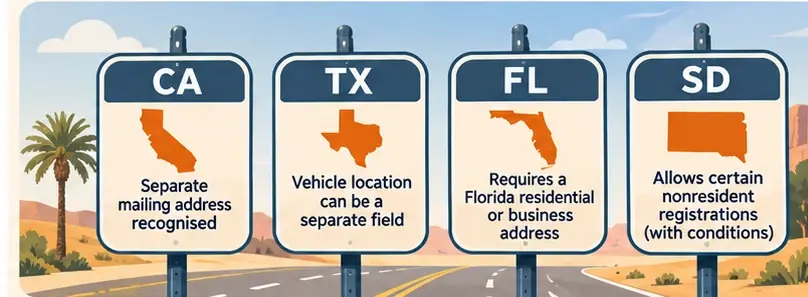
The following four examples show why the address fields and the applicant's circumstances matter.
California: mailing and residential addresses can be different
California DMV explicitly distinguishes between a vehicle owner's residence or business address and a separate mailing address.
Its registration procedures require the application to include the registered owner's residence or business address, plus the mailing address when different.
The department also explains that vehicle registration documents may display only the mailing address, even though both addresses are recorded during the application process.
This is useful for people who have a genuine California residence but prefer to receive correspondence elsewhere.
For example, someone living at a residential address that does not receive reliable mail delivery might use a separate permitted mailing arrangement.
However, a mailing address does not replace the obligation to supply accurate residential or business information.
California also requires registered and legal owners to report applicable address changes within 10 days.
Practical lesson: A virtual mailbox may be suitable for correspondence, but the underlying residential or business-address requirement remains.
Official source: California DMV: Addresses on Registration Documents.
Texas: the vehicle's physical location matters
Texas DMV's application instructions distinguish the vehicle's mailing address from its physical location when those are different.
Its vehicle change-of-address form also states that when a PO Box is listed as the owner's address, the physical location of the vehicle must be provided separately.
Texas additionally distinguishes the owner on record from someone designated to receive registration-renewal notices.
This means a person may be able to receive certain registration correspondence somewhere other than the vehicle's normal location.
It does not mean that a private mailbox establishes where the vehicle is kept.
Texas DMV also advises that people living outside Texas generally must register vehicles in the state or jurisdiction where they currently live, with specified exceptions such as certain students and active-duty military personnel.
Practical lesson: Check both where registration is legally required and which addresses must be reported.
Official sources:
Florida: a physical residential or business address is required
Florida's vehicle registration requirements are particularly important because the governing law was amended for 2026.
Under Florida Statutes §320.02, the registration application generally must include the street address of the owner's permanent Florida residence or permanent Florida place of business.
Individual applicants must also supply proof of address satisfactory to the department and qualifying identification.
The law includes specific provisions, including an exemption from the permanent-residence street-address requirement for certain active-duty military members who are Florida residents.
A virtual mailbox subscription does not independently establish a permanent Florida residence or business location.
Florida also generally requires vehicle owners to report address changes within 30 days, subject to statutory exceptions.
Practical lesson: Don't assume that having a Florida mailing address makes you eligible to register a vehicle there.
Official source: Florida Statutes §320.02, 2026.
South Dakota: special considerations for nonresidents and full-time travellers
South Dakota is frequently discussed by RVers and full-time travellers because its vehicle registration system accommodates certain nonresident applicants.
The South Dakota Department of Revenue explains that people living outside the state may apply to title and register vehicles there, subject to its requirements.
However, this does not mean that anybody can simply buy a South Dakota mailbox and register a vehicle without further checks.
Applicants must provide accurate ownership, identification and location information.
The state's motor vehicle procedures distinguish between people who actually reside elsewhere and genuine nomads who do not maintain a physical residence in any state.
Its published procedures describe an affidavit process for qualifying applicants without a residential address, including circumstances in which a mail-forwarding address may be used.
South Dakota also imposes an additional $100 title administration fee on certain applicants without a South Dakota-issued driver's license or ID, or a physical South Dakota address.
For this fee, the state explicitly excludes PO Boxes and mail-forwarding addresses from the definition of a physical address.
These vehicle requirements should not be confused with the separate eligibility procedures for a South Dakota driver's license.
And registering a vehicle in South Dakota does not automatically override another state's registration requirements or determine where the vehicle may legally be insured.
Practical lesson: If you're a full-time traveller, confirm the current title and registration procedure with the relevant South Dakota county treasurer before purchasing a mailbox service.
Official sources:
What if you travel full-time in an RV?
Full-time RVers face an unusual practical problem: their vehicle may also be their home.
They may travel through several states, stay at campgrounds or temporary locations and receive correspondence through a mail-forwarding service.
A virtual mailbox can make mail management easier, but registration eligibility is still a separate issue.
The questions to ask include:
- Which state are you legally required or permitted to register the vehicle in?
- Does that state have special procedures for genuine full-time travellers?
- What evidence is required to establish your circumstances?
- Must you disclose where the vehicle is kept or principally used?
- Are there separate requirements for your driver's license and insurance?
Some states have procedures that recognise people without conventional homes. But those procedures are not interchangeable, and the eligibility requirements may differ between agencies.
For example, South Dakota's vehicle title procedures and driver's-license procedures are distinct.
Do not assume that meeting one automatically establishes eligibility for the other.
For practical correspondence arrangements, see our guide to receiving mail while travelling full-time in an RV.
Does a virtual mailbox affect vehicle insurance?
This is one of the most important questions to resolve before changing your registration arrangements.
Vehicle insurance companies may consider where a car is kept or principally used when assessing risk and setting premiums.
That location is sometimes called the garaging address.
The garaging address may differ from the mailing address where you receive insurance documents.
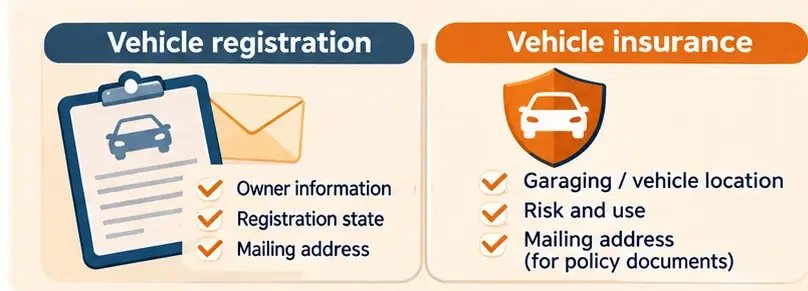
For example, a person might live and keep their car in one area while using a virtual mailbox in another city for correspondence.
The insurer may still need accurate information about where the vehicle is normally kept.
New York's Department of Financial Services explicitly advises customers to verify both their mailing address and their vehicle's garaging address when these differ.
Washington state's insurance regulator likewise identifies where a vehicle is kept as a potential factor in premiums.
Providing a mailbox address instead of the vehicle's true location could cause problems with underwriting, premiums or policy coverage.
If you travel full-time and do not have a conventional garaging location, explain your circumstances to the insurer and ask what information it requires.
A registration address should never be used to disguise the actual location or use of a vehicle.
Official sources:
- New York Department of Financial Services: Insurance Discounts and Savings
- Washington Insurance Commissioner: How Insurance Companies Set Auto Premiums
Can you register a vehicle in a different state just by renting a mailbox there?
Generally, no.
Renting a virtual mailbox in another state doesn't, by itself, establish eligibility to register a vehicle there.
Registration obligations may depend on your residence, where the vehicle is used or kept, the type of vehicle and applicable exceptions.
Some jurisdictions allow specific forms of nonresident registration. Others require vehicles used by residents to be registered locally.
For example, Texas DMV advises people who currently live outside Texas to register vehicles in their current jurisdiction unless a recognised exception applies.
South Dakota permits certain nonresident registrations, but that doesn't make them an automatic solution for people whose home state requires local registration.
A mailbox subscription is a service for receiving correspondence. It is not evidence that you have moved to another state.
Before attempting out-of-state registration, check the requirements of both the proposed registration state and the jurisdiction where you actually live or keep the vehicle.
Can you use a virtual mailbox for a vehicle title?
Possibly for permitted correspondence, but title applications may also require accurate information about the owner and other interested parties.
A vehicle title is different from its registration.
The title concerns legal ownership and may include lienholder information. Registration concerns the vehicle's authorisation for road use under the applicable rules.
Some applications handle address information differently for owners, lienholders and mailing recipients.
You should therefore check the title form separately rather than assuming that a mailbox accepted for renewal notices will automatically qualify for all title-related fields.
If you are financing or leasing a vehicle, the lender or lessor may also have requirements concerning the address information on file.
What if you move or change your mailbox provider?
Changing your mailing service may require updates to more than one record.
Depending on your circumstances, you may need to notify:
- The state motor vehicle agency.
- Your vehicle insurer.
- Your lender or leasing company.
- Other organisations that send vehicle-related correspondence.
Be especially careful if you're changing both your physical residence and mailing address.
California and Florida, for example, specify legal deadlines for reporting certain address changes.
A mailbox provider generally cannot update every relevant government and insurance record on your behalf.
For broader address-change planning, see our guide to updating your address when moving abroad.
Four mistakes to avoid
1. Treating a mailbox address as proof of residence
A street-style mailing address does not establish that you live at the mailbox provider's location.
2. Assuming registration and driver's-license rules are identical
States may use different forms, documentation and eligibility procedures for each.
3. Giving your insurer a mailing address instead of accurate vehicle-location information
Where a vehicle is kept can affect insurance requirements and pricing.
4. Assuming a successful registration overrides another state's laws
Being issued registration documents in one state does not necessarily resolve obligations that apply where you actually live or operate the vehicle.
Before purchasing a mailbox for vehicle registration
Check these five questions:
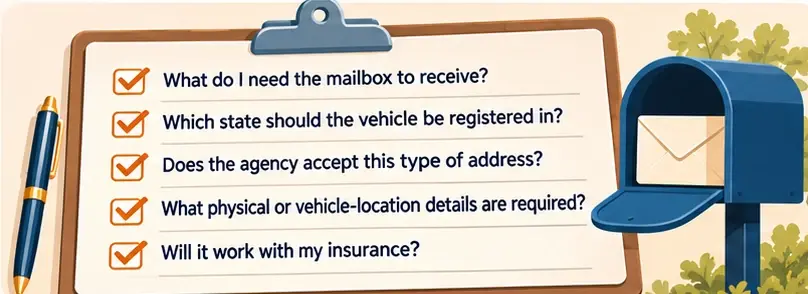
1. What do I need the mailbox to receive?
Renewal notices, title correspondence, registration documents or physical plates may have different delivery requirements.
2. Which state should the vehicle be registered in?
Don't make that decision solely based on where a mailbox provider offers addresses.
3. Does the registration agency accept this type of mailing address?
Confirm whether a commercial mail-receiving service is allowed for the relevant field.
4. What physical or vehicle-location information will I still need?
Determine whether residential, business or garaging information must be provided separately.
5. Will the arrangement work with my insurance?
Check the insurer's requirements before changing registration or address records.
Already have a virtual mailbox address?
AddressWise can help you investigate supported address characteristics and known restrictions, including vehicle-related categories where research is available.
However, it cannot establish legal residency, determine the correct registration jurisdiction or guarantee that a motor vehicle agency or insurer will accept a particular address.
Check your address with AddressWise
Frequently asked questions
Can I receive vehicle registration renewal notices at a virtual mailbox?
Potentially, yes. Some agencies permit a mailing address that differs from the owner's residence or the vehicle's physical location. Acceptance of a specific commercial mailbox depends on the agency.
Can I use a UPS Store mailbox to register my car?
A UPS Store mailbox may be useful for receiving permitted correspondence. It does not automatically satisfy residential, business or vehicle-location requirements.
Can I register my car in South Dakota if I don't live there?
South Dakota permits certain nonresident registrations, subject to its rules. Applicants must provide accurate information and should check whether registration in South Dakota complies with the requirements of their actual home jurisdiction.
Can full-time RVers register vehicles without a permanent house?
Potentially. Some states provide procedures for qualifying travellers without conventional residential addresses. Documentation and eligibility requirements vary.
Does the vehicle's insurance address have to match the registration mailing address?
Not necessarily. An insurer may record a mailing address separately from the vehicle's actual garaging or principal-use location. The information supplied must be accurate and satisfy the insurer's requirements.
Can I receive license plates through a virtual mailbox?
It depends on the issuing agency's delivery rules and whether the mailbox provider accepts and forwards the particular items. Confirm both before relying on the service.
Can a virtual mailbox replace my home address on the vehicle registration?
Not automatically. Even if an agency permits a separate mailing address to appear on some documents, it may still require your actual residence or business address in its records.
Can I use a virtual mailbox for both my driver's license and vehicle registration?
Possibly for permitted mailing purposes, but licensing and registration have separate requirements. Confirm each individually.
The bottom line
A virtual mailbox can make vehicle-registration correspondence much easier to manage, particularly for travellers and people who receive mail away from home.
But it is not a substitute for the information a state requires about where an owner lives, where a business operates or where a vehicle is kept.
Before subscribing, identify which registration requirements apply to you, verify the exact mailbox arrangement and make sure your insurance information remains accurate.
Research reviewed: 16 November 2026.
This guide provides general information from official state motor vehicle and insurance sources. It is not legal or insurance advice. Rules may vary by state, application type and individual circumstances.