Can You Use a Virtual Mailbox for a Bank Account?
Published
A virtual mailbox may be accepted as a mailing address for a US bank account, but it generally cannot replace the physical address a bank needs to verify your identity.
Whether you can use one depends on the bank, the type of account and what the address is being used for.
This distinction is particularly important if you travel full-time, live outside the United States, operate a small business or simply want your banking correspondence delivered somewhere other than your home.
Before purchasing a virtual mailbox specifically for banking, make sure you understand the difference between a mailing address and the address your bank needs for identification.
Mailing address vs physical address: what's the difference?
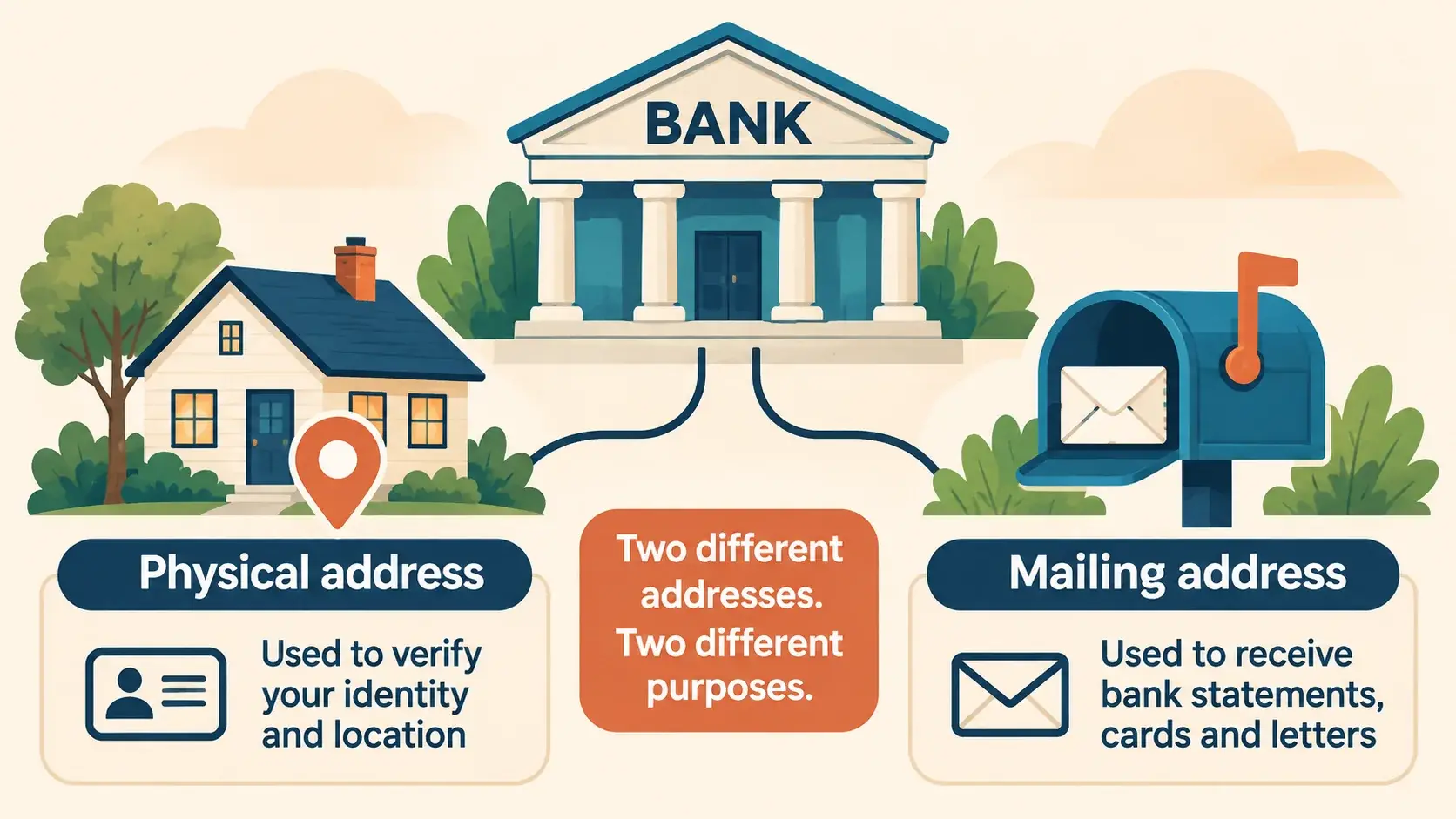
Banks may need more than one address for a customer.
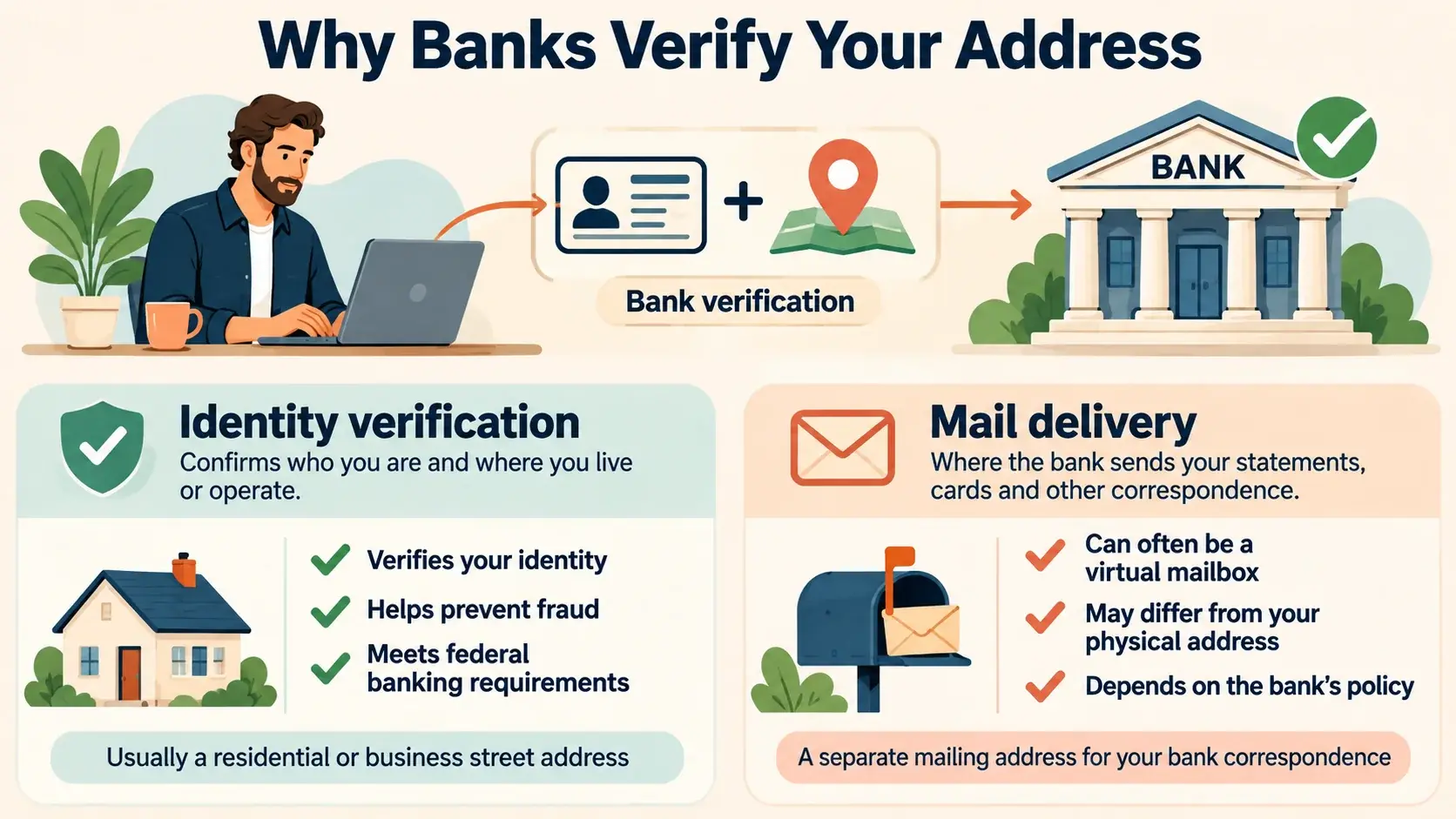
A physical address helps the bank identify you and establish where you live or conduct business. Federal customer-identification requirements generally call for an individual's residential or business street address.
A mailing address is where the bank sends correspondence when physical mail is required.
These addresses do not necessarily need to be the same.
| Address purpose | Can a virtual mailbox work? |
|---|---|
| Receiving permitted bank statements and letters | Often possible, depending on the bank |
| Receiving replacement debit or credit cards | Depends on the bank's delivery and security policies |
| Personal account identity verification | A mailbox alone generally isn't sufficient |
| Business account physical-location verification | A mailbox alone generally isn't sufficient |
| Separate mailing address on an existing account | May be permitted, subject to bank policy |
For example, someone who lives at a conventional residential address might ask their bank to send permitted correspondence to a virtual mailbox.
The bank would still retain the physical-address information it requires.
A valid postal address is not automatically an acceptable identity-verification address.
For the broader distinction between mailing addresses, residential addresses and domicile, see Can you use a virtual mailbox as your permanent address?.
Why do banks require a physical address?
US banks have legal obligations to identify customers and maintain procedures designed to prevent financial crime.
One important requirement is the Customer Identification Program, commonly called CIP.
Under 31 CFR §1020.220, a bank's procedures must generally obtain identifying information including:
- Your name.
- Your date of birth, if you're an individual.
- An acceptable address.
- An identification number, such as an applicable taxpayer identification number or other permitted document number.
For individuals, the address generally means a residential or business street address.
For businesses, it means a principal place of business, local office or another physical location.
These rules help the bank form a reasonable belief that it knows the customer's identity. The FFIEC CIP examination manual explains the required information and risk-based verification procedures.
The FDIC's discussion of the final CIP rule distinguishes required physical-address information from an additional mailing address a bank may obtain.
This is why a virtual mailbox subscription, even one providing an ordinary-looking street address, does not automatically satisfy the bank's identification requirements.
Is a virtual mailbox illegal for banking?
No. A virtual mailbox is a legitimate mail-receiving service when operated in accordance with applicable postal requirements.
The problem is not that virtual mailboxes are inherently unlawful.
The problem arises when an address intended for receiving mail is used to satisfy a requirement for someone's actual physical location.
A bank may permit a mailbox for correspondence while refusing to accept it as the address used for customer identification.
Can a bank reject a virtual mailbox address?
Yes.
Banks have their own account-opening procedures, documentation requirements and risk-based verification policies.
For example, Wells Fargo's published business banking requirements state that registered agent addresses, virtual addresses and PO/commercial mailboxes cannot be used as the required physical address.
Capital One's published commercial and small-business deposit-account rules also require a street address and state that a PO Box cannot be used for that purpose. These two examples concern business accounts; check the separate terms for a personal account.
These examples demonstrate that having a street number and ZIP Code is not, by itself, enough.
However, they should not be read as a universal prohibition against using a separate virtual mailbox for correspondence.
You need to check the exact bank and account type.
Before applying, ask whether the institution supports a mailing address different from your verified physical address, and whether a commercial mail-receiving agency is permitted for that purpose.
Can you use a virtual mailbox with an existing bank account?
Possibly.
If your account is already open, you may be able to change its mailing address without changing your physical residential address.
For example, someone who travels frequently may want correspondence sent to a mailbox service that can notify them when letters arrive.
That does not mean the bank no longer needs accurate information about their actual residence or operating location.
You should distinguish between:
Changing your mailing address: Where permitted correspondence will be delivered.
Changing your residential or business address: Updating where you actually live or operate, as required by the bank.
Some banks allow these details to be managed separately. Others may restrict particular address changes, require supporting evidence or use additional security checks.
A change may also affect how your bank delivers cards, checks or other sensitive documents.
Don't assume that updating an address online has changed only the mailing field. Confirm which account records have been updated.
What if you live full-time in an RV?
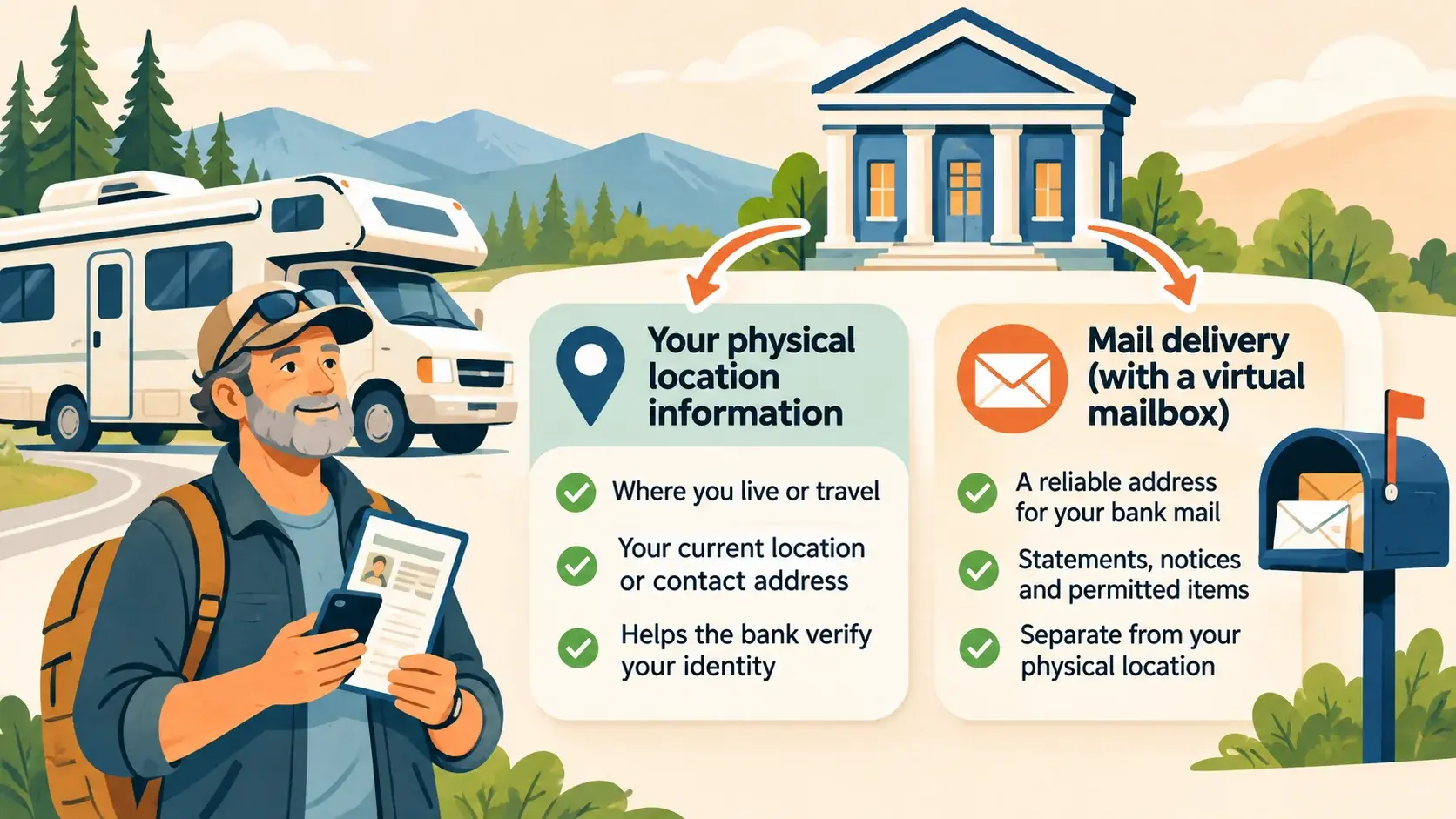
Full-time RVers may have a practical reason to use virtual mailbox services: they need dependable access to mail while moving between locations.
But receiving bank correspondence and verifying an address remain separate questions.
If you have an established residential or business street address, your bank may require you to continue providing accurate information about that location.
If you genuinely have no residential or business street address, federal CIP rules provide certain alternative identification arrangements.
These can include an APO or FPO address, or the residential or business street address of a next of kin or another contact individual.
Federal interpretive guidance also recognises that, in some circumstances, a description of the customer's physical location can be sufficient. Its rural-route example permits this where a rural-route number and a residential or business street address for a next of kin or other contact individual are unavailable.
These alternatives do not mean a customer may simply select any virtual mailbox and declare it a residence.
They also do not guarantee account approval. Banks must follow their own compliant identification procedures.
If you live full-time in an RV, explain your circumstances to your bank and ask which alternative documentation or address procedure it supports.
For general mail arrangements, see our guide to receiving mail while travelling full-time in an RV.
What if you have no fixed address?
A person without a conventional residential address may still be able to open a bank account.
The federal customer-identification rules recognise that not everyone has a standard residential or business street address.
Depending on the circumstances and the bank's procedures, the institution may be able to use permitted alternative contact-address information or a description of the customer's physical location.
There is an important difference between having no conventional fixed address and supplying a false one.
Do not claim to live at a commercial mailbox simply because the bank's application requires a street address.
Instead, contact the bank directly and explain your circumstances.
You can ask whether its procedures accommodate people without fixed housing and what identification or supporting information it requires.
The bank may request documents or use non-documentary methods of verification. The exact arrangements will depend on its policies.
Can Americans living abroad use a US virtual mailbox for banking?
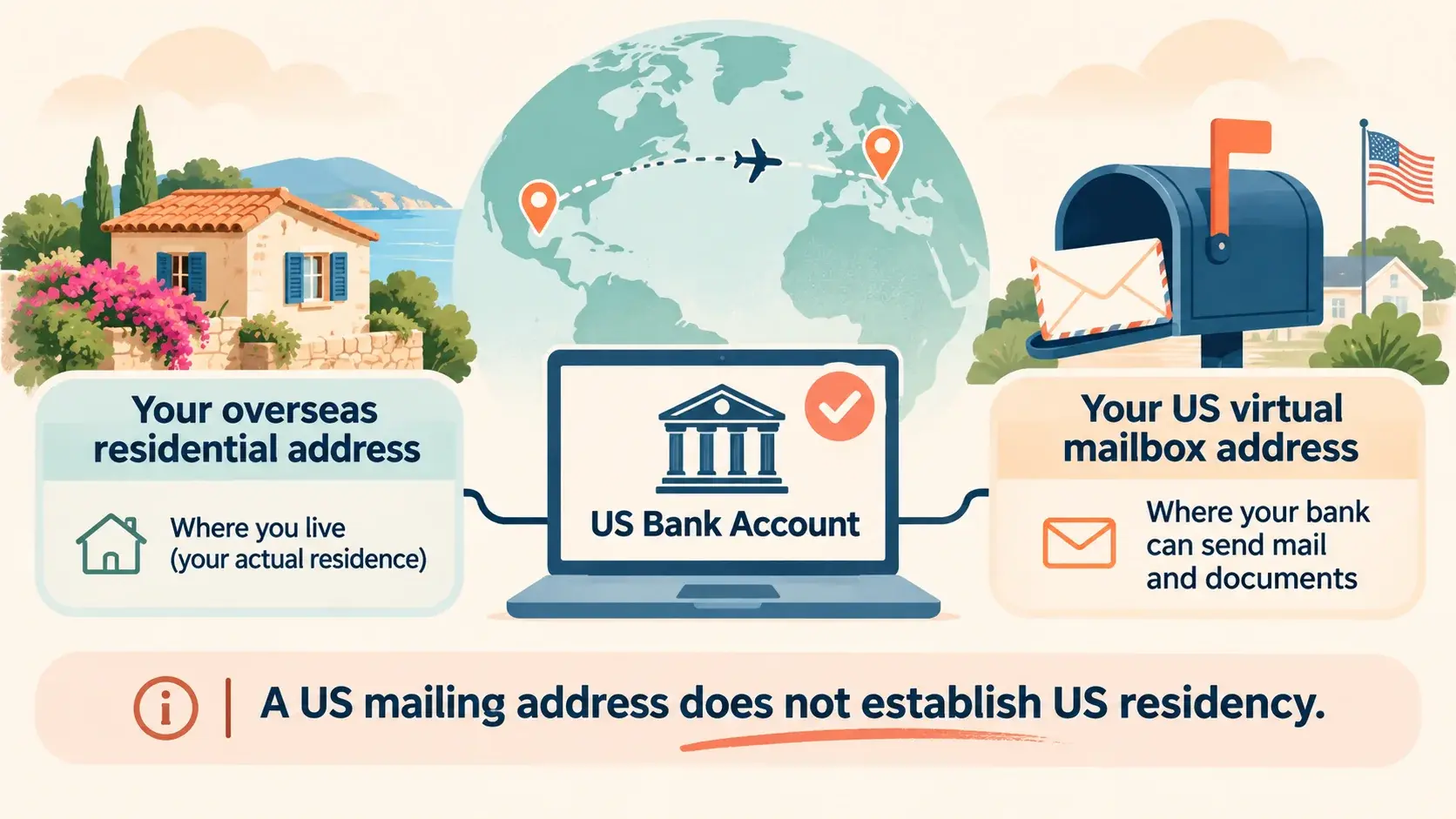
A virtual mailbox can help Americans overseas receive certain US banking correspondence.
However, maintaining a US mailing address does not necessarily establish US residency or satisfy a bank's account eligibility requirements.
A bank may need your actual residential address abroad, additional identity documentation or information about your tax residency.
Some banking products may also be unavailable to customers living in particular countries, regardless of their mailing address.
If you're moving overseas, it is sensible to contact your existing bank before departure and ask:
- Can I retain this account while residing in my destination country?
- Can you record my overseas residential address?
- Can I use a separate US virtual mailbox for correspondence?
- Are there restrictions on card delivery or other account services?
- What documentation will be required after I move?
Do not keep an old US residential address on file as your current home if it no longer accurately describes where you live.
A virtual mailbox can solve a mail-management problem. It cannot, on its own, solve international banking eligibility.
For related planning, see our guide to managing your US mail when moving abroad.
What about business bank accounts?
Business accounts have their own address requirements.
Under federal CIP rules, banks generally need an appropriate physical location for a legal entity, such as its principal place of business, local office or another physical location.
A virtual mailbox may be useful for business correspondence but does not automatically establish where the company operates.
This is especially relevant to owners of LLCs formed using separate mailing and registered agent addresses.
For a detailed explanation, see our guide: Can You Use a Virtual Mailbox Address for an LLC?.
The key point is that a state accepting an address on an LLC filing does not mean a bank must accept that address for business-account verification.
Why does a bank recognise my virtual mailbox as a commercial address?
A virtual mailbox often operates through a Commercial Mail Receiving Agency, or CMRA.
These businesses receive mail on behalf of customers using private mailbox numbers.
USPS has specific rules for the address format, including the use of PMB or # followed by the private mailbox number.
Although a CMRA may have an ordinary street address, it remains a commercial mail-receiving location.
A bank may independently determine that the supplied address is associated with a mailbox provider or may request evidence establishing where the customer actually lives or operates.
If that happens, don't try to disguise the mailbox by replacing the proper designation with an invented apartment number.
Use the address accurately, and ask the bank which separate address information it requires.
For CMRA authorisation and identification, read our USPS Form 1583 guide.
Official source: USPS Publication 28, Section 285.
What should you do if your bank rejects the address?
First, find out exactly why the address was rejected.
A rejected address does not always mean the same thing.
The institution may be unable to validate the postal address, may prohibit mailbox services for a particular field or may need additional evidence of your physical location.
A practical approach is to:
- Ask which address requirement failed. Was it the physical-address field or a separate mailing-address restriction?
- Check the address formatting. Make sure the mailbox provider's required postal format is correct.
- Provide accurate physical-address information. If you have a qualifying residential or business address, ask the bank how it should be recorded.
- Explain any unusual circumstances. If you live full-time on the road or have no fixed address, ask about permitted alternative procedures.
- Confirm the final arrangement. Find out where statements, cards and notices will be delivered, and which physical-address information the bank retains.
Never assume that changing PMB to Suite will make the address acceptable.
If the bank's policy does not permit your chosen mailing arrangement, you may need a different correspondence solution or an institution whose published requirements accommodate your circumstances.
Before buying a virtual mailbox for banking
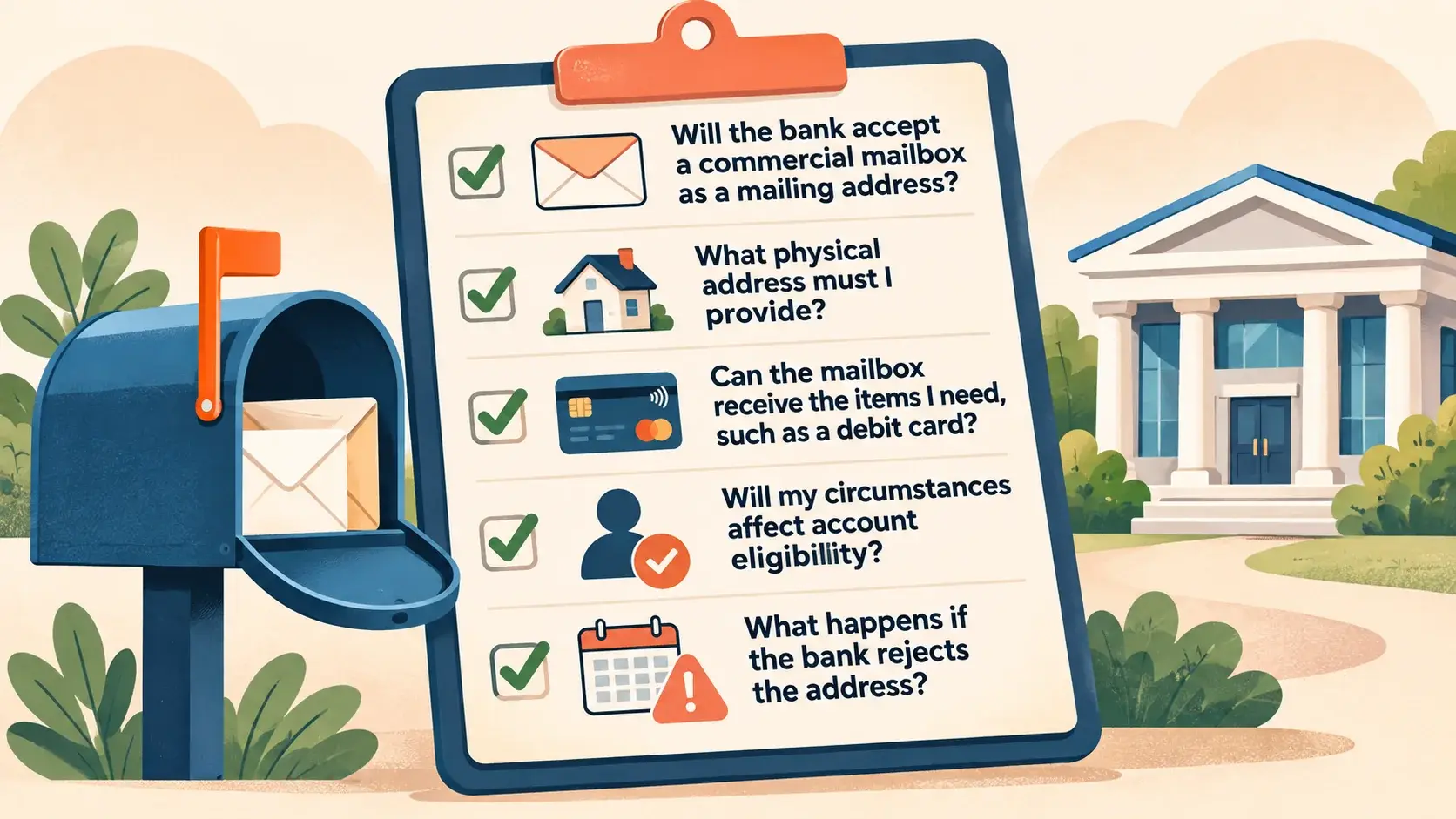
Ask these five questions first.
1. Will the bank accept a commercial mailbox as a separate mailing address?
Don't confuse permission to receive correspondence with identity-verification requirements.
2. What physical-address information must I provide?
Check whether the bank needs a residential or business street address, and what alternatives are available if you genuinely have neither.
3. Can the mailbox receive the items I need?
Statements, replacement cards, checks and sensitive documents may be handled differently.
4. Will my circumstances affect account eligibility?
Living abroad, travelling full-time or operating a business may introduce requirements beyond ordinary mail delivery.
5. What happens if the bank rejects the mailbox?
Understand the provider's cancellation terms and whether you can use an alternative address arrangement before committing to a long subscription.
Already have a virtual mailbox address?
AddressWise can help you inspect supported characteristics and uses of an address, including certain known limitations and conditions.
Address Checker does not verify personal identity or assess individual bank policies.
However, the Address Checker cannot determine whether an individual bank will approve your identity, accept a particular mailing address or open an account.
The bank's own requirements remain decisive.
Check an address with AddressWise
Frequently asked questions
Can I open a checking account using only a virtual mailbox?
A virtual mailbox alone generally does not satisfy the physical-address information required under federal customer-identification rules. There are special alternatives for individuals who genuinely have no residential or business street address.
Can I use a virtual mailbox as my bank's mailing address?
Potentially, yes. Some banks permit a separate mailing address, but acceptance of commercial mailbox services depends on the institution and account.
Can I receive a debit card at a virtual mailbox?
Possibly, but not every bank permits cards or sensitive account materials to be sent to commercial mailboxes. Confirm the specific delivery policy before relying on the service.
Can I use a UPS Store mailbox for a bank account?
It may be acceptable for certain correspondence arrangements, but a UPS Store private mailbox does not automatically qualify as a physical residential or business address.
Can I use a friend's address for banking?
Federal rules provide a limited alternative involving a contact person's street address when an individual lacks a residential or business street address. This is not general permission to claim that you live at a friend's home. Ask the bank which procedure applies and provide accurate information.
Will a virtual mailbox keep my home address hidden from the bank?
No. The bank may still need your actual physical-address information for customer identification, even if it allows a separate mailbox for correspondence.
Do online banks have the same address requirements?
Online banks remain subject to applicable customer-identification requirements. Their online account-opening processes may also have institution-specific address and eligibility restrictions.
Does a bank accepting my mailbox mean other banks will accept it?
No. Account approval and mailing-address policies differ between institutions and products.
The bottom line
A virtual mailbox can be a useful way to manage bank correspondence, but it is not a substitute for the physical-address information banks generally require.
The safest approach is to confirm the bank's rules before purchasing a mailbox, keep your residential or business information accurate, and use the mailbox only for purposes the institution permits.
For travellers, Americans abroad and people without conventional addresses, the correct solution may involve an alternative identification procedure rather than simply finding a different mailbox provider.
Research reviewed: 16 November 2026.
This guide provides general information about US banking and mail-address requirements. It is not legal or financial advice. Bank policies and account eligibility requirements can change, and the relevant institution determines whether a particular arrangement is acceptable.