Can You Use a Virtual Mailbox Address for an LLC?
Published
Yes, a virtual mailbox can often be used as an LLC's mailing address. But it cannot automatically replace the business's physical address or registered agent's address.
The important distinction is what the address will be used for.
When you form an LLC, apply for an Employer Identification Number (EIN), open a business bank account or register with a state agency, you may encounter several different address fields.
They don't necessarily have the same requirements.
Understanding those differences before purchasing a mailbox can help you avoid rejected applications, banking problems and unnecessary changes to your LLC records.
Which LLC addresses can be virtual mailboxes?
Here's a practical starting point.
| Address type | Can you use a virtual mailbox? |
|---|---|
| Business mailing address | Usually, provided the recipient accepts it |
| Mailing address on LLC formation documents | Often, depending on the state's filing requirements |
| Registered agent address | Not a mailbox-only service |
| Principal office or physical business address | Depends on state requirements and where the business actually operates |
| IRS EIN mailing address | Generally, yes |
| Physical business address for banking | A mailbox alone is generally insufficient |
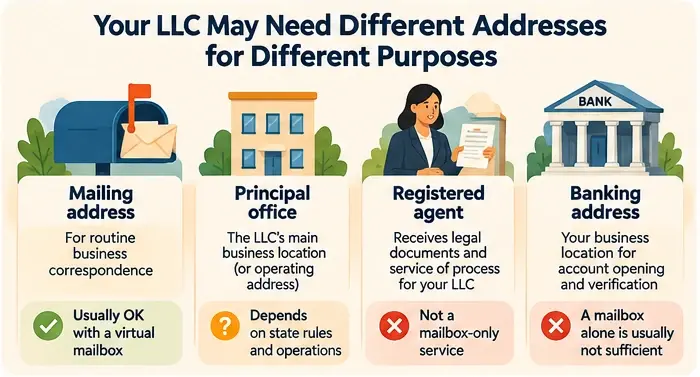
These distinctions matter even if every address looks like an ordinary street address.
For example, a virtual mailbox may use a commercial building's street address followed by a private mailbox number. That does not necessarily mean your LLC operates from the building.
Before entering an address on an application, identify exactly which type of address the form requests.
For the broader distinction between personal mailing addresses, residential addresses and domicile, see Can you use a virtual mailbox as your permanent address?.
1. Using a virtual mailbox as your LLC's mailing address
This is one of the most straightforward uses of a virtual mailbox.
A business mailing address is where your LLC receives correspondence. It might be used for supplier letters, customer communications, routine business records or correspondence from agencies that permit a separate mailing address.
With a virtual mailbox, a commercial mail-receiving business accepts mail on your LLC's behalf. Depending on the service and plan, you may be able to view incoming envelopes online, request document scans and arrange forwarding.
This can be particularly useful if you:
- Run your LLC from home and want a separate business mailing address.
- Travel frequently or work remotely.
- Live outside the United States but operate a US LLC.
- Want business correspondence managed separately from household mail.
However, using a virtual mailbox for correspondence does not automatically establish that the LLC operates at that address.
It also does not guarantee that every bank, government agency or business platform will accept it for every purpose.
What does USPS require?
Virtual mailbox services commonly operate through commercial mail receiving agencies, or CMRAs.
USPS requires customers to complete Form 1583 to authorise a qualifying CMRA to receive mail on their behalf.
Private mailbox addresses must also follow USPS addressing conventions, including the appropriate PMB or # designation.
You should not change the address format to make the mailbox appear to be a conventional office.
For more information, see our USPS Form 1583 guide and virtual mailbox setup guide.
Official sources: USPS CMRA rules and USPS Form 1583 and USPS Publication 28, Section 285.
2. Can you use a virtual mailbox when forming an LLC?
Often, but you need to distinguish between the mailing address and the principal office or registered office.
State formation forms are not identical.
Consider four examples.
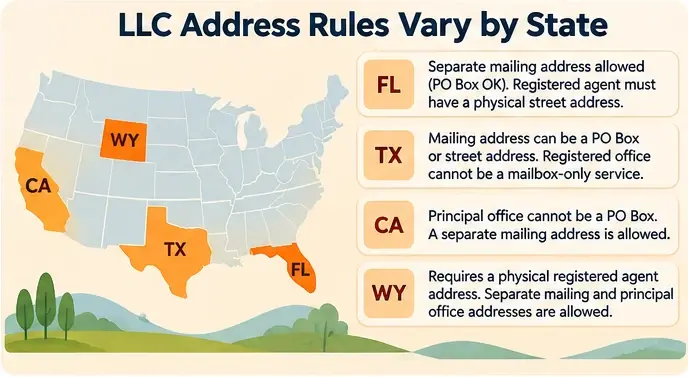
Florida
Florida's LLC formation instructions request the street address of the company's principal office.
They also allow a separate mailing address, explicitly stating that a PO Box is acceptable in the mailing-address field.
The registered agent must have a physical Florida street address.
That means Florida provides separate fields for functions that a single virtual mailbox cannot necessarily fulfil.
Official source: Florida Division of Corporations, LLC Filing Instructions.
Texas
Texas requires an initial mailing address for an LLC. Its official formation instructions permit a PO Box or street address for this purpose.
The registered office is different.
Texas explicitly says the registered office cannot consist solely of a mailbox service or telephone answering service. It must be a street address where legal documents can be personally served on the registered agent during normal business hours.
Official sources: Texas Secretary of State, Form 205 Instructions and Form 205 with initial mailing-address instructions.
California
California's Articles of Organization form distinguishes between the LLC's initial street address of principal office and its mailing address.
The principal-office field explicitly prohibits a PO Box.
The mailing-address field is separate, if the mailing address differs.
This distinction does not mean every commercial mailbox automatically qualifies as a principal office merely because it has a street address.
Official source: California Secretary of State, Articles of Organization Form LLC-1.
Wyoming
Wyoming's LLC filing form provides separate fields for the registered agent's physical address, the LLC's mailing address and the LLC's principal office address.
Its registered agent requirements include a physical Wyoming address. A drop box is not acceptable, and a PO Box cannot serve as the registered agent's only address.
Official source: Wyoming Secretary of State, LLC Articles of Organization.
What do these examples tell us?
An LLC might legitimately use different addresses for different purposes.
A founder working from home, for example, may need:
- A genuine business operating address where required.
- A professional registered agent who accepts legal service.
- A virtual mailbox for permitted routine correspondence.
These don't necessarily need to be the same location.
The correct arrangement depends on your formation state, your business activities and the requirements of each organisation involved.
3. Can a virtual mailbox be your LLC's registered agent address?
A mailbox-only service generally cannot act as your LLC's registered office.
A registered agent is the person or qualifying business appointed to receive legal documents and formal service of process on behalf of your LLC.
That is different from a business that simply receives envelopes and scans their contents.
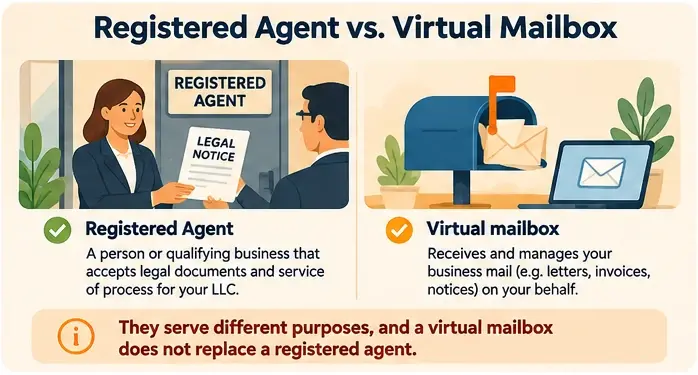
For example, Florida requires its registered agent to have a physical street address in the state. Texas additionally specifies a street location where service can be personally delivered during normal business hours and prohibits an office consisting solely of a mailbox service.
A virtual mailbox subscription does not automatically satisfy these requirements.
However, some companies offer both registered agent and mail-handling services.
If a provider offers both, check which address is supplied for each purpose and whether the registered agent independently satisfies the state's requirements.
Don't assume that buying a mailbox automatically includes registered agent services.
4. Can you use a virtual mailbox when applying for an EIN?
The IRS distinguishes between a mailing address and a physical street address on Form SS-4, the application for an Employer Identification Number.
The form includes:
Lines 4a–4b: Mailing address
These identify where the entity receives correspondence. The IRS permits a mailing address that differs from the company's physical location.
Lines 5a–5b: Street address
These request the entity's physical address if different from its mailing address. The IRS instructions explicitly say not to enter a PO Box in this field.
A suitable virtual mailbox may therefore be used for the EIN application mailing address, but that does not make it a substitute for the entity's actual physical location when that information is required.
The IRS also asks for the county and state where the principal business is located.
If your LLC operates from overseas, additional considerations apply. The IRS instructions accommodate foreign addresses, and a US mailing address does not automatically make the business physically located in the United States.
Official source: IRS Instructions for Form SS-4.
What if your LLC's mailing address changes?
Businesses can use IRS Form 8822-B to report changes to their mailing address or business location.
It's worth keeping those records accurate rather than assuming that changing your virtual mailbox provider will automatically update the IRS.
Official source: IRS Form 8822-B.
5. Can you use a virtual mailbox to open an LLC bank account?
This is where problems can arise even when an LLC was successfully formed using a virtual mailbox for correspondence.
Banks have separate customer-identification obligations.
Under federal Customer Identification Program requirements, a bank generally needs identifying information about the business, including a principal place of business, local office or another physical location.
A virtual mailbox may be acceptable as a separate mailing address, depending on the bank.
But a mailbox-only arrangement does not automatically satisfy the physical-address requirement.
Banks may also request formation documents, identity verification, ownership information or evidence supporting the business's actual operating location.
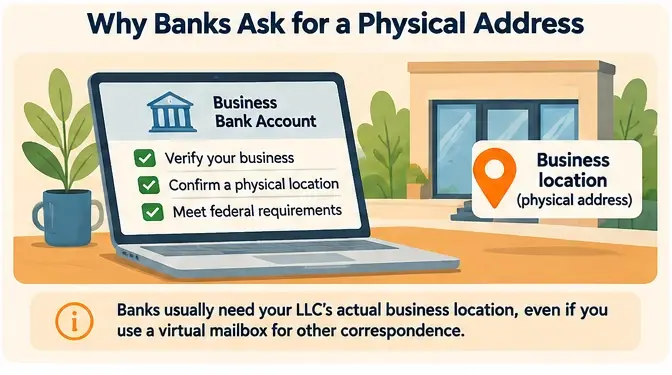
A common problem
Imagine that a founder forms an LLC and places a virtual mailbox address on a state filing.
Later, the founder applies for a business bank account.
The bank requests evidence of the actual business operating address, such as appropriate business documentation.
The founder only has a mailbox subscription.
The state may have accepted the address for a mailing field, but that does not establish that the business operates at the mailbox location or mean that the bank must accept it.
Before forming your LLC, it is sensible to check the address requirements of any bank you intend to use.
Official source: Customer Identification Program Requirements, 31 CFR §1020.220.
For personal accounts, address changes and no-fixed-address procedures, see Can you use a virtual mailbox for a bank account?.
6. Will a virtual mailbox keep your home address private?
It can help reduce how often you need to use your home address for business correspondence.
For example, you might use an appropriate virtual mailbox on invoices, supplier communications and other materials where a mailing address is sufficient.
However, a virtual mailbox cannot guarantee that your residential address will never appear in public records.
Formation documents, annual reports and other filings may request physical business addresses, registered agent information or details about members and managers.
Some of those records may be publicly accessible.
The availability of alternative addresses and the amount of information disclosed depend on the state and the specific filing.
If privacy is particularly important, investigate which addresses will appear on the public record before submitting the formation paperwork.
Don't assume that a registered agent service automatically conceals every other address connected to your LLC.
7. What if you run a US LLC while living abroad?
A virtual mailbox can be especially useful for entrepreneurs operating US businesses from outside the country.
It can provide a place to receive permitted US business correspondence, access scanned mail and arrange delivery of physical documents when necessary.
However, you should distinguish three things:
- Where your LLC is legally formed. This is determined by its formation jurisdiction.
- Where the business actually operates. This depends on the facts of your business.
- Where the LLC receives mail. This may be a separate virtual mailbox address.
A US mailing address does not automatically establish a physical US office, determine tax residency or satisfy a bank's requirements.
For founders who live overseas, it is particularly important to confirm the documentation needed by the proposed bank, formation state and IRS.
You may also need professional advice about tax and registration obligations across the jurisdictions involved.
For help managing correspondence from overseas, see our guide to managing US mail while living abroad.
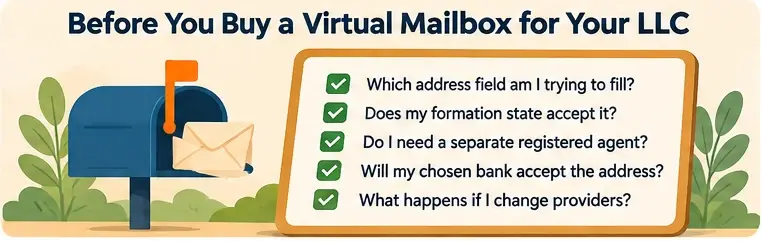
8. Five things to check before buying a virtual mailbox for your LLC
Before subscribing, ask yourself:
1. Which address field am I trying to fill?
Is it a general mailing address, the principal office, a registered agent address or a physical-address field on a bank application?
2. Does my formation state accept this arrangement?
Review the state's actual filing instructions rather than relying only on the mailbox provider's marketing description.
3. Do I need a separate registered agent?
If so, check that the provider offers a genuinely qualifying registered agent service, not just mail forwarding.
4. Will my chosen bank accept the address?
Confirm what is needed for business identity verification, including any proof of physical location.
5. What happens if I change mailbox providers?
Find out which state records, IRS information, banks and business contacts may need updating.
A little research before formation can prevent expensive changes afterward.
9. Already have a virtual mailbox address?
AddressWise can help you inspect supported characteristics and uses of an address, including known limitations and conditions.
Its current checks focus on supported personal address uses; it does not assess LLC formation or registered-agent eligibility.
However, the Address Checker does not guarantee that an LLC formation agency, registered agent authority, IRS office or bank will accept a particular address.
The applicable institution's requirements remain decisive.
Check your address with AddressWise
Still choosing how to form your LLC?
If you're comparing formation services, our companion website Formation Field provides an LLC formation cost calculator and provider reviews.
Use it to explore formation-service costs separately from your virtual mailbox requirements.
Frequently asked questions
Can I register an LLC using a virtual mailbox address?
You may be able to use one for the LLC's mailing address. Whether the same address can be used for other formation fields depends on the state and the nature of the address.
Can I use a virtual mailbox instead of a registered agent?
No. A virtual mailbox subscription does not, by itself, satisfy registered agent requirements. A provider may offer a separate qualifying registered agent service.
Can an LLC use a PO Box?
A PO Box is allowed for certain mailing-address fields. Florida and Texas expressly permit one in the relevant LLC mailing-address field. That does not make a PO Box acceptable as a registered office or physical business address.
Can I use my home address for my LLC?
Often, yes, subject to state filing requirements and applicable business rules. However, an address used in public filings may become publicly accessible.
Can a virtual mailbox receive IRS correspondence?
It may be suitable as the entity's mailing address under IRS Form SS-4 rules, provided the arrangement is valid and the address is entered accurately.
Can I open a business bank account with a virtual mailbox?
A bank might accept a virtual mailbox for correspondence, but normally needs qualifying information about the business's actual physical location. Ask the bank before relying on a mailbox address.
Do I need a mailbox in the same state as my LLC?
Not necessarily for ordinary correspondence. But a registered agent generally must satisfy the requirements of the state where the entity is registered, and other address fields may have separate location requirements.
The bottom line
A virtual mailbox is often an excellent mailing solution for an LLC, but it is not a universal business address.
The safest approach is to identify which addresses your business actually needs, check the relevant state and institutional rules, and use each address for its proper purpose.
That way, your LLC can benefit from the convenience of virtual mail management without confusing mail delivery with legal presence, business operations or registered agent obligations.
Research reviewed: 13 November 2026.
This guide provides general information based on published government and regulatory sources. It is not legal, tax or banking advice. Requirements can vary by jurisdiction, institution and individual circumstances.